Backpack vs Briefcase: Which Is Better for Work?
Choosing between a backpack and a briefcase is not simply a question of style. The right work bag depends on what you carry, how far you travel, the environments you move through and the impression you want your bag to create.
A work backpack generally suits people who walk, cycle, use public transport or carry a laptop and several daily essentials. A briefcase may suit professionals who travel lighter, handle documents frequently or prefer a more structured bag for offices and client meetings.
Neither format is universally better. The most useful comparison is the one built around your actual working day.

Figure 1: A work backpack and briefcase solve different problems; the best choice depends on load, commute, workplace setting, access needs and travel habits.
Backpack vs Briefcase: Quick Comparison
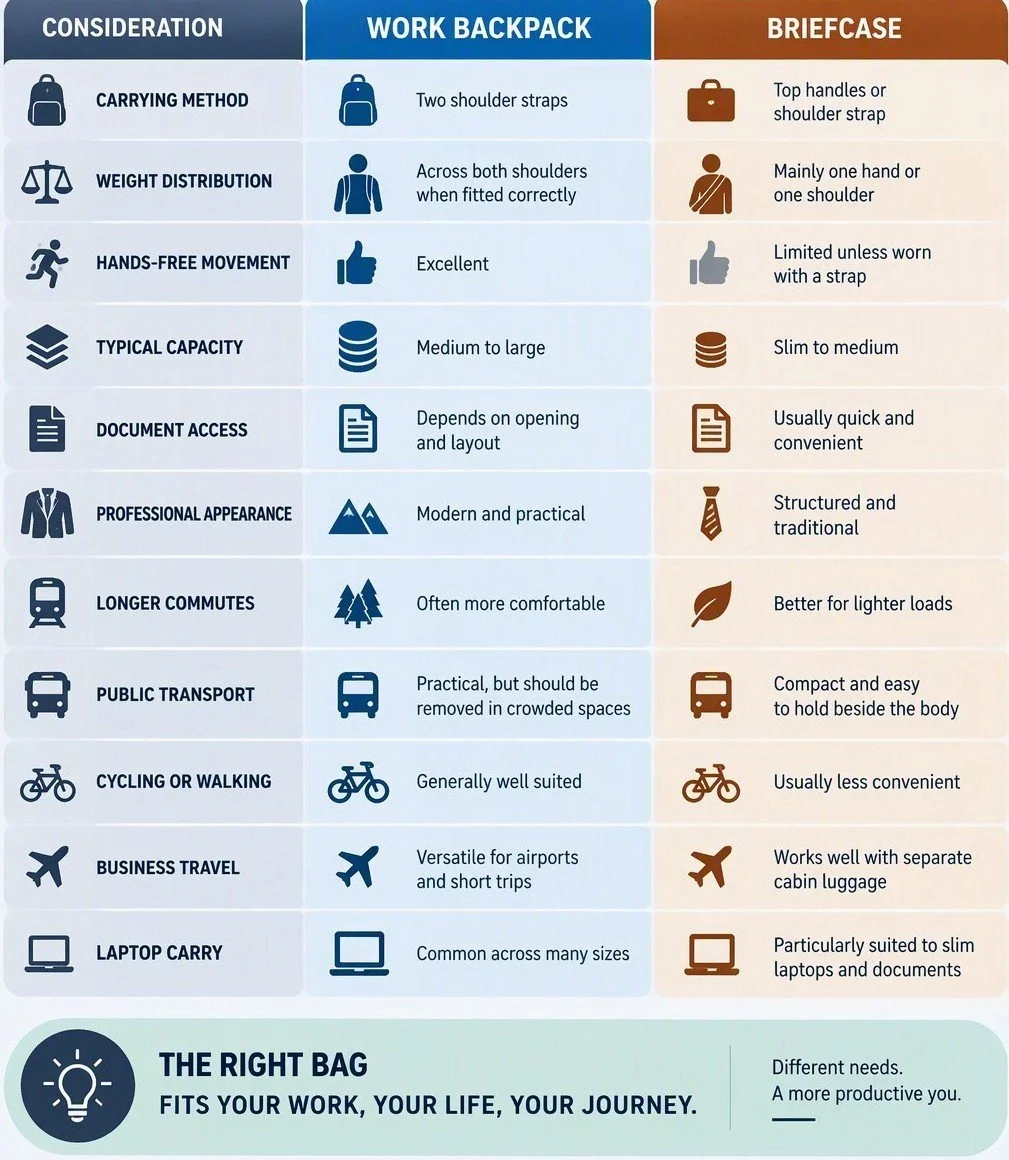
These are general tendencies rather than fixed rules. A slim professional backpack can be more compact than an expandable briefcase, while a large leather briefcase may weigh more than a lightweight fabric backpack.
What Is a Work Backpack?
A work backpack—or business backpack—is designed to combine the two-strap carrying format of a traditional backpack with the organisation and appearance expected of an office bag.
Unlike a hiking pack or school bag, a professional backpack usually has a cleaner silhouette, restrained colours and dedicated storage for work equipment. Depending on the design, it may include:
A padded laptop compartment
A tablet or document sleeve
Organiser pockets for chargers and cables
Padded, adjustable shoulder straps
A structured back panel
Secure internal or rear-facing pockets
A luggage pass-through for attaching it to a suitcase
Water-resistant materials or a protective finish
Space for lunch, headphones, a jacket or gym clothing
Work backpacks range from compact laptop backpacks to expandable business travel backpacks. The important question is not how many litres a bag can hold, but whether its size and internal layout match what you genuinely carry.
What Is a Modern Briefcase?
The modern briefcase is far removed from the rigid attaché case associated with earlier office life. Most contemporary work briefcases are soft-sided or semi-structured and may be made from leather, canvas, nylon, polyester, coated textiles or synthetic alternatives.
A business briefcase will commonly include:
Top carry handles
A padded laptop section
Flat storage for A4 documents
Internal pockets for pens, cards and accessories
A detachable shoulder strap
One or more zipped compartments
A rear pocket or luggage sleeve
Structured panels that help the bag retain its shape
The horizontal layout is one of the briefcase’s defining strengths. Laptops, folders and notebooks can often be placed inside without stacking them vertically or reaching into a deep compartment.
1. Carrying Comfort and Weight Distribution
Comfort is one of the clearest differences in the backpack vs briefcase comparison.
When both straps are worn and adjusted correctly, a backpack carries weight across both shoulders. This can be useful when walking to a railway station, changing between buses and trains, moving through an airport or carrying equipment between different workplaces.
The design and fit still matter. Wide, adjustable straps, a supportive back panel and a stable structure can improve carrying comfort. The backpack should sit close to the body rather than hanging loosely behind it, and heavier equipment is generally easier to manage when positioned close to the back.
A briefcase concentrates its load in one hand or on one shoulder. This may be perfectly comfortable when the contents are limited to a lightweight laptop, charger, notebook and a small number of personal items. As the load becomes heavier or the journey becomes longer, one-sided carrying may become tiring.
A detachable shoulder strap gives a briefcase more flexibility, but it remains a single-strap system. Changing hands or alternating shoulders may help prevent repeatedly carrying the bag on the same side.
Practical guide: if your work bag regularly feels heavy before you leave home, a two-strap business backpack may be easier to manage. If your daily load is compact and your walking distance is short, either style may be suitable.
2. Laptop Protection and Technology Organisation
Both a laptop backpack and a laptop briefcase can protect technology effectively. The bag format matters less than the construction of the compartment.
Look for a laptop section that:
Matches the external dimensions of your device
Holds the laptop securely without excessive movement
Has padding on the front, back and base
Separates the device from keys, cables and hard objects
Keeps drink bottles in a different area
Closes securely
Does not place the laptop directly against the ground
Do not rely only on a screen-size label. Two laptops described as 15-inch or 16-inch devices may have different chassis dimensions. Compare the bag’s actual internal measurements with the length, width and thickness of your laptop.
A professional backpack may be preferable for a larger or heavier laptop because the load can be carried across both shoulders. It may also offer more room for headphones, power supplies, adapters and other technology.
A slim laptop briefcase works well when the computer is the main item being carried. Its horizontal layout also makes it easy to take out a laptop in a meeting room, shared workspace or airport security area.
3. Documents, Organisation and Everyday Access
A briefcase has a natural advantage when printed documents are central to the working day. A4 folders, presentation materials and notebooks can usually be stored flat and reached without disturbing the rest of the bag.
This makes the format useful for professionals who regularly carry:
Contracts or signed documents
Client files
Presentation folders
Reports and notebooks
Plans or printed reference material
A backpack can offer equally effective organisation, but the design needs to be chosen carefully. A deep, open compartment may allow documents to bend or disappear beneath other items. If paperwork matters, look for a structured document sleeve, internal dividers or a full-length zip opening.
Access also differs while moving. A briefcase can be opened while positioned on a chair, desk or lap. A backpack usually needs to be taken off first, although external pockets can make frequently used items easier to reach.
For either format, too many small pockets can become as frustrating as too few. Effective organisation means that your laptop, charger, phone, keys and documents each have a logical place.
4. Professional Appearance and Workplace Style
The briefcase has a long association with formal business clothing, legal and financial environments, executive offices and client-facing work. Its structured horizontal form often complements suits, tailored jackets and traditional office wear.
That does not mean a backpack is inherently unprofessional.
Modern professional backpacks are available with slim profiles, subdued hardware, minimal branding and clean lines. A black or dark brown leather backpack can feel quite different from a brightly coloured sports pack. Likewise, a structured textile business backpack may fit naturally within technology, consulting, design, healthcare, education and hybrid workplaces.
Rather than applying a universal rule, consider:
How formal your workplace is
Whether you attend external client meetings
What your colleagues and customers typically carry
Whether your bag will be seen in presentations or executive settings
How the bag works with your usual clothing
Whether you want a traditional or contemporary professional style
A leather briefcase can create a classic appearance, while a leather work backpack may combine a more refined material with hands-free functionality. Canvas, nylon, polyester and coated materials can also look professional when the silhouette and details are restrained.
Professionalism comes from the complete design—not simply the material or whether the bag has shoulder straps.
5. Commuting by Train, Bus, Car or Bicycle
Your commute may be the most important factor in choosing a work bag.
Walking and public transport
A commuter backpack leaves both hands free for using a transport card, holding a handrail, carrying an umbrella or opening doors. This can be particularly useful in Sydney, Melbourne, Brisbane and other cities where a workday may include walking and multiple public-transport connections.
In crowded trains or buses, however, a backpack should generally be removed and held by its top handle or placed between your feet. This takes up less space and gives you better awareness of the bag.
A briefcase is easy to keep close to the body and can fit neatly beside a seat. The trade-off is that it occupies one hand unless fitted with a shoulder strap.
Driving
If most of your journey is from home to a car park and then into an office, the ergonomic difference may be less significant. A briefcase can be convenient to place on a passenger seat, while a backpack may offer more capacity for errands or after-work activities.
Cycling
A well-fitted backpack generally provides greater stability for cycling because it can be secured close to the body and leaves both hands free. Reflective details, weather protection and stable straps may be useful for active commuters.
A hand-carried briefcase is not appropriate while cycling. A shoulder strap may improve practicality, but movement and balance should be considered. A pannier or cycling-specific work bag may be a better solution for regular riders.
6. Capacity: Carry What You Need, Not Everything You Can
Business backpacks often provide greater capacity than slim briefcases. That makes them useful for people carrying lunch, a drink bottle, a jacket, commuting shoes, gym clothing or equipment for a short trip.
Extra space is not always an advantage. A large work backpack can encourage overpacking, add unnecessary empty weight and become awkward in crowded spaces.
A briefcase encourages a more edited daily carry. For someone who needs only a laptop, charger, notebook and a few personal items, that limitation can be helpful.
Before choosing, place everything you carry on a typical day on a table. Include occasional essentials rather than hypothetical ones. Then consider whether they require:
A separate laptop compartment
Flat A4 storage
A sealed bottle pocket
Space for clothing
Quick access to keys or a phone
Separation between work equipment and personal items
The best work bag is not the largest one. It is the smallest format that comfortably handles your real routine without being tightly packed.
7. Business Travel and Carry-On Use
For frequent travellers, both formats can work well, but they tend to play different roles.
A business travel backpack may function as the primary cabin bag for a short trip. Clamshell openings, luggage sleeves and separate technology compartments can make it easier to move between airports, hotels and offices.
A briefcase often works better as a personal item alongside a small suitcase. It keeps a laptop, travel documents and meeting materials close at hand without requiring the user to fit clothing into the same bag.
Airline allowances vary by carrier, route, cabin and aircraft. A bag marketed as “carry-on compatible” is not automatically suitable for every flight. Check its packed external measurements and empty weight against the current rules of the operating airline.
Laptop users should also consider how easily electronic devices and batteries can be accessed. Travel requirements generally make cabin storage important for laptops, power banks and spare batteries, so a secure and accessible technology section is valuable.
8. Security in Crowded or Shared Spaces
Security depends more on bag design and behaviour than on backpack or briefcase format.
A backpack may place external pockets outside your direct line of sight. For public transport and airports, lockable zip pulls, internal valuables pockets and rear-facing compartments can provide additional control.
A briefcase is often carried beside the body, making its main opening easier to monitor. However, an open pocket or unsecured flap is still vulnerable regardless of the bag style.
For either option, consider:
Whether the main compartment closes fully
The durability and position of the zips
A discreet pocket for passport, wallet or phone
Whether the bag can remain upright beside a desk
How easily you can keep hold of it in a café or shared workspace
Whether confidential documents remain covered and secure
9. Materials, Empty Weight and Weather
Leather, canvas and synthetic textiles can all be appropriate for a professional work bag. No material category guarantees durability or weather protection on its own.
A leather backpack or leather briefcase may offer natural texture, structure and a polished appearance. The leather type, surface finish, thickness and care requirements will influence how it handles moisture and daily wear.
Textile bags may provide lower empty weight and a broad range of weather-resistant coatings. Heavy canvas, layered construction and extensive hardware can still make a textile bag substantial.
Look beyond the material name and inspect:
Empty bag weight
Stitching at straps and handles
Zipper quality
Base and corner reinforcement
Laptop-compartment padding
Lining and internal seams
Edge finishing
Attachment of buckles and hardware
Product-specific water-resistance information
“Leather”, “canvas”, “nylon” and “vegan leather” are categories, not complete performance specifications. Construction quality and intended use are just as important.
Which Work Bag Suits Your Routine?
For commuters
A professional backpack often suits people who walk, use trains or buses and carry a moderate daily load. Hands-free movement and two-shoulder carrying are the main advantages.
For executives and client-facing professionals
A structured briefcase may align more naturally with formal clothing and traditional meeting environments. A minimalist business backpack can still work where the culture is contemporary or business casual.
For frequent business travellers
Choose according to your luggage system. A backpack may serve as an all-in-one bag for short trips, while a slim briefcase can work effectively as a personal item paired with cabin luggage.
For laptop-heavy users
A backpack may be more comfortable when the laptop, power supply and accessories create a heavier load. A briefcase may be ideal for a slim laptop and limited supporting equipment.
For people carrying printed documents
A briefcase usually provides easier horizontal storage and access. Backpack users should look for a dedicated, structured document section.
For active or hands-free commuters
Walking, cycling and frequent movement generally favour a stable backpack. Look for adjustable straps, an appropriate fit and a bag that does not shift while moving.
For minimalists
If you carry little and prefer a compact office bag, a slim laptop briefcase may prevent unnecessary packing. A compact backpack can offer the same discipline with a different carrying style.
Final Verdict: Choose for the Journey, Not Just the Office
The backpack vs briefcase decision has no universal winner.
A work backpack tends to suit longer commutes, heavier technology, hands-free mobility and days that move between work, travel and personal activities. A briefcase tends to suit lighter loads, printed documents, quick access and settings where a structured professional appearance is preferred.
Before deciding, consider the entire journey: leaving home, travelling to work, moving through the office, attending meetings and returning at the end of the day.
The better work bag is the one whose carrying system, capacity, organisation, appearance and maintenance requirements match the way you genuinely work.
NORETI
The Art of Distinction.
Resources & Further Reading
The following resources were used to ground the article’s guidance and maintain a balanced comparison:
Safe Work Australia — Lifting, Pushing and Pulling (Manual Tasks): Australian guidance on carrying, sustained force, awkward posture and musculoskeletal risk.
Genitrini, Dotti, Bianca and Ferri — Impact of Backpacks on Ergonomics: Narrative review examining load, pack design, load position, straps, posture, comfort and energy use.safeworkaustralia
Son and Noh — Gait Changes Caused by the Habits and Methods of Carrying a Handbag: Research examining one-sided bag-carrying habits and gait.mdpi
Qantas — Carry-On Baggage Allowances: Current Australian domestic and international bag dimensions, weight allowances and personal-item guidance.nih
Virgin Australia — Carry-On Baggage: Current cabin-baggage and personal-item requirements.qantas
International Air Transport Association — Safe Travel with Lithium Batteries: Guidance for laptops, electronic devices, power banks and spare batteries during air travel.virginaustralia
Leather Working Group — List of Definitions: Industry terminology for leather, grain, split leather, finishes and related material descriptions.iata
Leather Naturally — How to Care for Leather: Material-specific guidance covering pigmented leather, aniline leather, nubuck, suede, moisture and maintenance.leatherworkinggroup