The Journal
Stories of Style, Design & Distinction
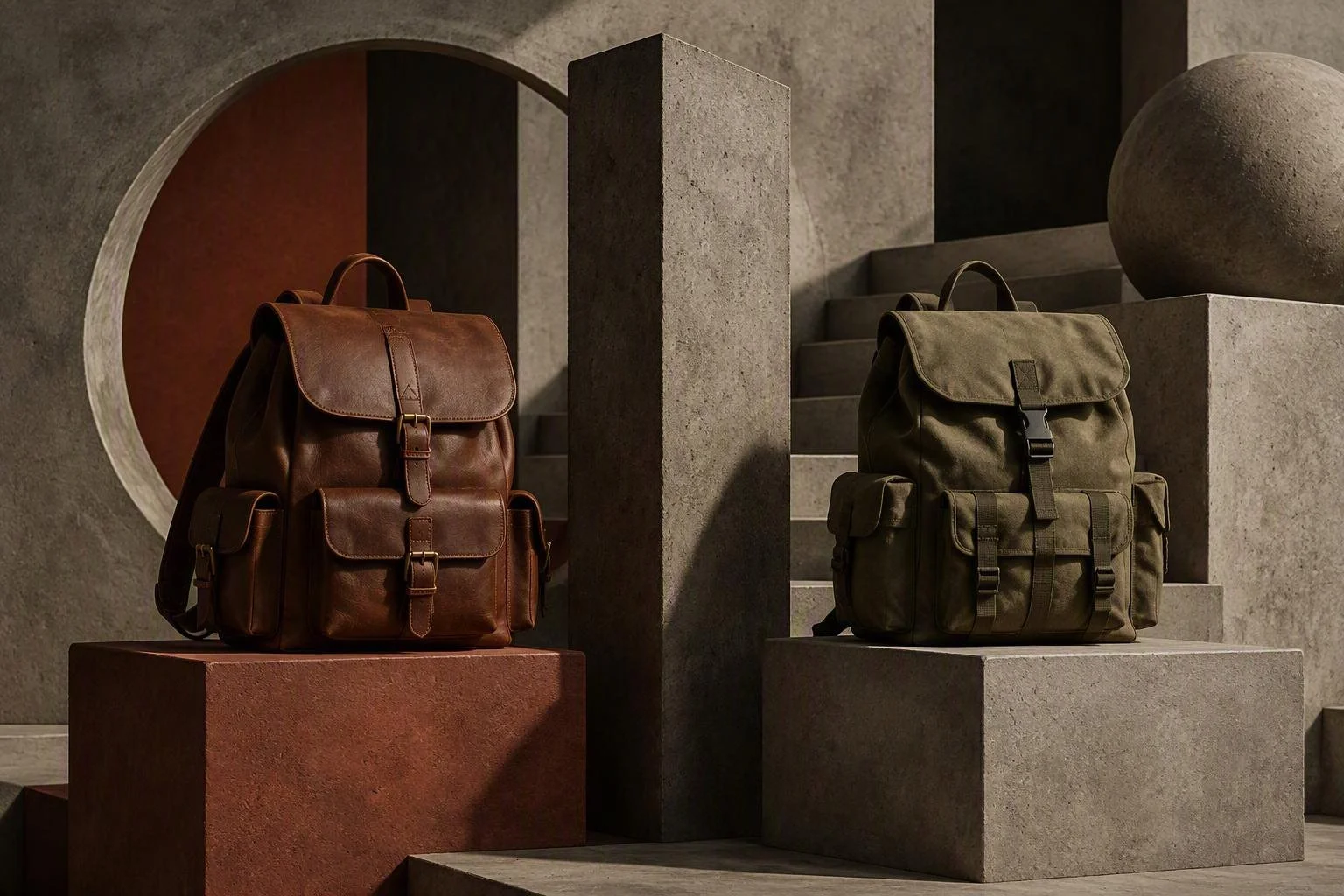
Full-Grain Leather Backpack vs Canvas Backpack: Which Is Better?
Choosing between a full-grain leather backpack and a canvas backpack is not about finding a universal winner. Each material offers distinct advantages in durability, weight, style, maintenance, weather resistance, and long-term value. In this guide, we compare leather and canvas backpacks side by side to help you determine which option best suits your lifestyle, travel needs, and personal preferences.
Choosing between a full-grain leather backpack and a canvas backpack is not simply a question of which material is better. Both can make excellent backpacks, but they serve different priorities.
Full-grain leather may appeal if you value natural character, structure, a polished appearance, and the possibility of a distinctive patina. Canvas may be more suitable if you prefer a relaxed look, greater flexibility, potentially lower weight, or a simpler everyday carry.
However, material is only part of the decision. Stitching, strap reinforcement, zippers, hardware, lining, padding, panel thickness, and overall design can have as much influence on a backpack’s performance as the outer material itself.
This balanced leather backpack vs canvas backpack comparison examines durability, weight, maintenance, weather behavior, appearance, travel, professional use, and long-term value so you can choose according to how you actually carry.
Full-Grain Leather and Canvas: Understanding the Materials
What is full-grain leather?
Full-grain leather retains the hide’s original grain surface after the hair and epidermis have been removed. The grain has not been removed through buffing, snuffing, or surface correction.
Importantly, “full-grain” describes the condition of the leather’s surface. It does not, by itself, guarantee a particular thickness, finish, level of water resistance, or service life. Those characteristics also depend on the animal hide, tannage, finish, manufacturing specifications, and construction of the finished backpack.
This distinction matters when comparing products. Two backpacks labeled “full-grain leather” may have very different weights, finishes, lining materials, hardware, and levels of protection.
What is canvas?
Canvas is a woven fabric commonly made from cotton, although canvas can also incorporate polyester or other fibers. Many cotton canvas fabrics use a plain weave, in which warp and weft yarns cross in an alternating pattern.
Plain-weave fabrics have frequent yarn intersections, which can create a stable fabric with relatively low susceptibility to skew, snagging, seam slippage, or picking. However, canvas performance still varies with yarn quality, fabric weight, weave density, fiber composition, and surface treatment.
Common backpack variations include:
Untreated cotton canvas
Heavyweight canvas
Cotton duck or duck canvas
Waxed canvas
Cotton and synthetic blends
Coated or proofed canvas
Therefore, the word “canvas” should not be treated as one fixed performance specification. A lightweight untreated canvas backpack and a heavyweight waxed canvas backpack can behave very differently.
Leather Backpack vs Canvas Backpack: Quick Comparison
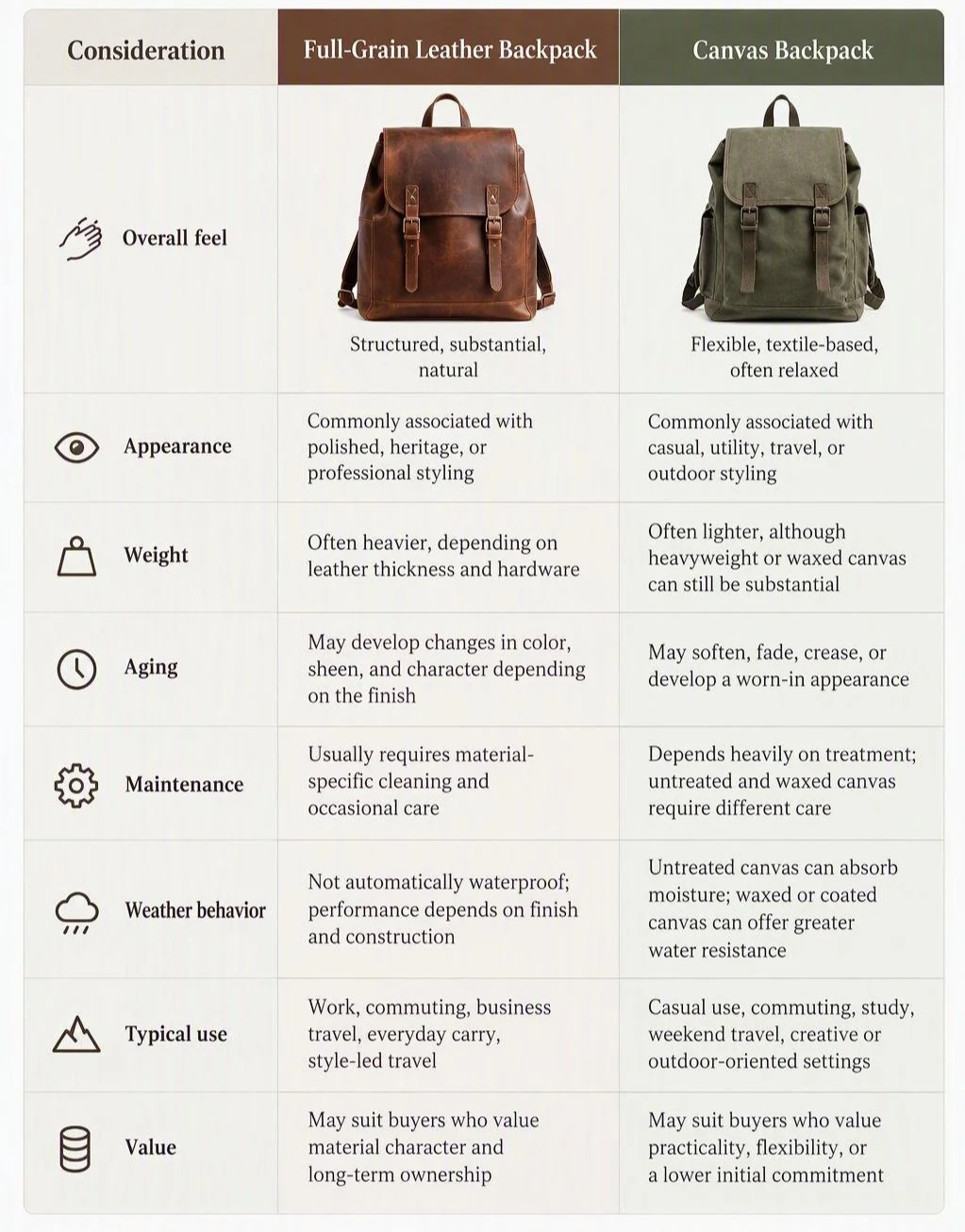
These are general tendencies, not universal rules. A lightly constructed leather backpack may weigh less than a heavily reinforced waxed canvas model, while a premium canvas backpack may cost more than an entry-level leather one.
Which Material Is More Durable?
Both full-grain leather and quality canvas can be durable, but they respond to use in different ways.
Full-grain leather retains its original grain surface, but the label alone does not prove how a finished backpack will perform. Leather thickness, tanning, finish, stitching, edge construction, lining, and reinforcement must all be considered.
Canvas durability is similarly variable. A tighter weave, heavier fabric, suitable coating, and reinforced construction can improve performance, while lighter canvas may prioritize flexibility and reduced weight.
Construction can matter more than the material name
When evaluating backpack durability, inspect:
Shoulder-strap attachment points
Reinforcement at handles and corners
Stitch consistency
Zipper quality and alignment
Bottom-panel protection
Lining and internal seams
Edge finishing
Hardware attachment
Repairability
Manufacturer care and warranty information
Even premium backpack materials cannot compensate for weak strap anchors, poorly installed zippers, or unreinforced seams. Reinforced stitching at stress points and reliable hardware contribute directly to the durability of a finished backpack.
A well-designed canvas backpack can therefore outperform a poorly constructed leather backpack—and the reverse is equally possible.
Weight and Carrying Comfort
Leather backpacks are often heavier because leather panels, substantial hardware, structured bases, and reinforced components can add weight. However, canvas should not automatically be described as lightweight. Heavyweight duck canvas, wax treatments, thick linings, leather trim, padding, and metal hardware can also produce a substantial bag.
For an accurate comparison, check the published empty weight of the exact backpack, rather than relying on material alone.
Comfort also depends on:
Shoulder-strap width
Strap shape and padding
Back-panel structure
Backpack dimensions
Load distribution
Placement of heavier items
Fit relative to the wearer
The weight carried each day
If you regularly walk long distances or need to meet airline carry-on weight limits, empty weight may be a major consideration. If you mainly commute by car or carry a modest daily load, structure, appearance, and organization may matter more.
How Leather and Canvas Age
The character of full-grain leather
Some full-grain leathers develop a patina as they are handled and exposed to everyday use. Patina may appear as changes in color, sheen, softness, and surface character.
The degree of change depends heavily on the leather’s finish. Aniline leather, for example, has little or no pigment finish, absorbs moisture more readily, and can develop a particularly visible patina. More protective pigmented finishes may age differently and offer greater resistance to liquids and staining.
Natural markings, color variation, and gradual changes are often part of the appeal of a full-grain leather backpack. Buyers who want a completely uniform appearance should examine the leather finish and product photographs carefully.
How canvas changes over time
Canvas generally develops a softer, more relaxed appearance with use. Depending on its color and finish, it may show fading, creases, rubbing, or wear at corners and high-contact areas.
Waxed canvas has its own form of character. The waxed surface can mark or crease where it is folded or handled, and scuffed areas may appear lighter. British Millerain describes these marks as normal characteristics of the waxed finish rather than manufacturing faults.
Waxed canvas can also be reproofed when its wax layer wears down, helping restore its weather-resistant properties and appearance.
Neither aging style is objectively better. Leather typically offers a more organic, polished evolution, while canvas often develops a softer, utilitarian, or adventure-worn character.
Weather and Water Resistance
Neither a full-grain leather backpack nor a canvas backpack should automatically be assumed to be waterproof.
Full-grain leather in wet weather
“Full-grain” is not a waterproof specification. Water behavior depends on tannage, surface finish, conditioning, seams, lining, closures, and the construction of the complete bag.
Some finished leathers can tolerate brief exposure to light moisture, while open-pore or lightly finished leather may absorb water more readily. Direct or prolonged exposure can cause staining, stiffening, color changes, or deformation in some leathers.
If a leather backpack becomes wet, allow it to dry naturally away from direct heat or intense sunlight. Forced heat can damage the material.
Canvas in wet weather
Untreated cotton canvas can absorb moisture. Waxed, coated, or proofed canvas can provide greater resistance, but water-resistant does not necessarily mean waterproof.
British Millerain, a specialist in waxed cotton, describes its fabrics as water resistant and recommends regular reproofing to maintain weather protection. The performance of a completed backpack also depends on seams, zipper construction, closures, lining, and openings—not only the outer fabric.
If protection from sustained rain is essential, look for a product-specific water-resistance claim or test information. Also examine protected zippers, storm flaps, coated linings, seam construction, and closure design.
Maintenance and Cleaning
Leather backpack care
Leather care should be based on the particular finish, not simply the term “full-grain.”
General principles include:
Follow the maker’s care instructions.
Remove loose dirt gently.
Use products formulated for the particular leather.
Patch-test any cleaner or conditioner in a hidden area.
Avoid harsh rubbing and household solvents.
Allow wet leather to dry naturally.
Do not apply conditioner automatically on a fixed schedule; assess the leather’s finish and condition first.
Leather Naturally notes that different leather finishes require different treatment. It also recommends patch testing, appropriate products, and natural drying away from direct heat.
Canvas backpack maintenance
Care requirements differ significantly between untreated, coated, blended, and waxed canvas.
Some untreated canvas products may permit hand or machine washing, while traditional waxed canvas often should not be machine washed, dry-cleaned, tumble-dried, ironed, or cleaned with detergent. These processes can remove or damage the wax finish.
For waxed canvas, the manufacturer may recommend brushing off dry dirt, carefully sponging localized areas with cold water, and reproofing when water no longer beads effectively.
Always follow the backpack’s own care label. “Canvas” alone does not tell you whether a product is washable.
Appearance: Professional or Casual?
A full-grain leather backpack often suits wardrobes and environments where a more structured or polished appearance is preferred. It can complement business-casual clothing, tailored outerwear, client meetings, and business travel.
Canvas generally has a more relaxed visual language. It works naturally with casual clothing, denim, weekend travel, creative workplaces, and outdoor-inspired wardrobes.
These are conventions rather than restrictions. A clean, minimal canvas backpack can look appropriate in many professional environments, while a softly structured leather backpack can work equally well with casual clothing.
Consider:
Your workplace dress expectations
The colors you wear most often
Whether you prefer a structured or relaxed silhouette
How visible wear and marks will make you feel
Whether you want the backpack to blend in or become a feature
Which Is Better for Work?
A full-grain leather backpack for work may suit you if:
You prefer a polished or structured appearance.
Your wardrobe leans toward business or smart casual.
You value natural material variation and patina.
You are comfortable with material-specific care.
A modest increase in empty weight is acceptable.
A canvas work backpack may suit you if:
Your workplace is casual or creative.
You walk or use public transportation frequently.
Flexibility and everyday practicality are priorities.
You prefer a less formal appearance.
You want a broader range of colors or textile finishes.
For either material, laptop protection, strap comfort, internal organization, and zipper security are likely to matter more during daily use than appearance alone.
Which Is Better for Travel?
A full-grain leather backpack may work particularly well for business trips, city travel, and journeys where presentation matters. Its structure can help maintain a clean silhouette, although empty weight and exposure to rain should be considered.
A canvas backpack for travel may suit weekend trips, road travel, and casual itineraries where flexibility and a relaxed appearance are preferred. Waxed canvas may provide additional weather resistance, but its care requirements should still be checked.
For frequent travel, compare:
Empty backpack weight
External dimensions
Carry-on suitability
Laptop protection
Luggage pass-through
Strap comfort
Security of closures
Weather protection
Ease of cleaning
Access while moving
The best backpack material for travel is the one that supports your particular journey—not the one that wins an abstract material comparison.
Is a Leather Backpack Worth It?
A leather backpack may be worth it when you value the feel of natural leather, a more refined appearance, structural character, and the way a particular leather changes with use.
It may be less suitable if your main priorities are minimum weight, minimal maintenance, frequent exposure to heavy rain, or a lower initial purchase price.
Similarly, canvas may represent better value if you prefer casual versatility, fabric flexibility, and a simpler ownership experience. Premium waxed or heavyweight canvas, however, may still require specialized care and can carry a premium price.
Instead of asking only, “Is a leather backpack worth it?”, consider:
Will I enjoy carrying it regularly?
Is its empty weight practical for me?
Does its organization suit my routine?
Am I willing to follow its care instructions?
Is the construction appropriate for my load?
Can worn parts be repaired?
Does the appearance fit most of my wardrobe?
Is the material appropriate for my local weather and travel habits?
Value is personal. A backpack used regularly and cared for properly may provide greater value than a cheaper option that does not suit your routine.
Frequently Asked Questions
What is the best backpack material?
There is no universal best backpack material. Full-grain leather may be preferable for natural character, structure, and polished styling. Canvas may be preferable for casual versatility, textile flexibility, and potentially lower weight. Construction quality and intended use should guide the final choice.
Are canvas backpacks waterproof?
Not necessarily. Untreated canvas can absorb moisture. Waxed, coated, or proofed canvas can be water resistant, but full waterproofing depends on the fabric treatment and complete bag construction, including seams, zippers, and closures.
Is full-grain leather waterproof?
No. Full-grain describes the retained grain surface; it does not establish waterproof performance. The finish and completed backpack must be evaluated for any water-resistance claim.
Which material lasts longer?
There is no reliable universal answer. Material thickness, finish, stitching, reinforcement, hardware, use, care, and repairability all influence lifespan. A well-constructed backpack in either material can be a strong long-term choice.
Which is lighter: leather or canvas?
Canvas backpacks are often lighter than comparable full-leather designs, but this is not guaranteed. Heavy canvas, wax, padding, lining, leather trim, and hardware can narrow the difference. Compare the exact empty weights of the products you are considering.
Final Verdict: Choose According to Use, Not a Universal Winner
In the full-grain leather backpack vs canvas backpack comparison, neither material is universally better.
Choose full-grain leather if you are drawn to natural character, structure, a polished appearance, and the possibility of a distinctive patina—and you are comfortable with its weight and care requirements.
Choose canvas if you prefer a relaxed aesthetic, greater flexibility, potentially lower weight, or a backpack suited to casual everyday use. If weather resistance matters, consider waxed or proofed canvas and confirm the performance of the completed bag.
Most importantly, look beyond the material label. Strong stitching, reinforced straps, dependable zippers, thoughtful organization, comfortable carrying, and appropriate weather protection determine whether a backpack will genuinely work for your life.
The right choice is not the material that wins every category. It is the backpack whose materials, construction, appearance, and care requirements best match how you intend to carry it.
NORETI — The Art of Distinction.
Explore the NORETI collection of premium leather bags, business accessories and contemporary travel essentials.
Resources & Historical Accuracy
To ensure this article is balanced, accurate, and based on recognized material standards rather than marketing claims, the following references were consulted:
Leather Definitions and Technical Standards
Leather Research Laboratory (Leather USA) – Definitions of full-grain and top-grain leather, including the internationally recognized definition of full-grain leather as leather retaining the original grain surface.
Source: Leather Research Laboratory, Leather Industries of America.International Organization for Standardization (ISO) and International Union of Leather Technologists and Chemists Societies (IULTCS) definitions referenced through Leather Research Laboratory.
Leather Care and Performance
Leather Naturally – Guidance on leather types, ageing, patina development, water exposure, cleaning, conditioning, and long-term care. Source: Leather Naturally Industry Fact Sheets.
Canadian Conservation Institute (Government of Canada) – Research on leather properties, water resistance, deterioration, humidity effects, and long-term preservation of leather products. Source: Canadian Conservation Institute, Caring for Leather, Skin and Fur.
Canvas and Textile Construction
CottonWorks™ – Technical information regarding woven cotton fabrics, plain-weave canvas construction, stability, and durability characteristics. Source: Cotton Incorporated, CottonWorks Learning Hub.
British Millerain – Historical and technical information on waxed cotton, including weather resistance, maintenance, reproofing, and the historical development of waxed canvas. Source: British Millerain, one of the world's oldest waxed cotton manufacturers.
Backpack Construction and Durability
Industry references on backpack construction, including:
Reinforced stitching
Strap attachment points
Hardware quality
Zipper performance
Material selection
These sources were used to support the principle that overall backpack longevity depends on construction quality as much as material choice.
Historical Context
Canvas backpacks trace their origins to heavy woven fabrics traditionally used for sails, tents, military packs, and work equipment. The word canvas is believed to derive from the Latin cannabis, referencing the hemp fibers originally used in its production.
Leather backpacks have origins in early travel, military, and trade equipment dating back thousands of years. Vegetable-tanned leather bags and packs were used throughout ancient civilizations, including the Roman Empire and later across Europe for travel, hunting, and commerce.
Waxed canvas emerged from maritime applications. Sailors treated canvas sails with oils to improve weather resistance. During the late 19th and early 20th centuries, manufacturers such as British Millerain refined the process into modern waxed cotton textiles used in outdoor clothing, luggage, and bags.
Accuracy Statement
This article intentionally avoids declaring either material as the universally superior choice.
Material performance depends on multiple factors, including:
Material quality
Fabric weight
Leather finish
Stitching methods
Hardware quality
Backpack design
Maintenance practices
Intended use
For this reason, comparisons are presented as general characteristics rather than absolute rules. Individual products may perform differently depending on their construction and specifications.
Last reviewed: October 2026
Author: NORETI
Review standard: Material characteristics, construction quality, practical ownership experience, and publicly available industry references.