The Journal
Stories of Style, Design & Distinction
Full-Grain vs Top-Grain Leather: What’s the Difference?
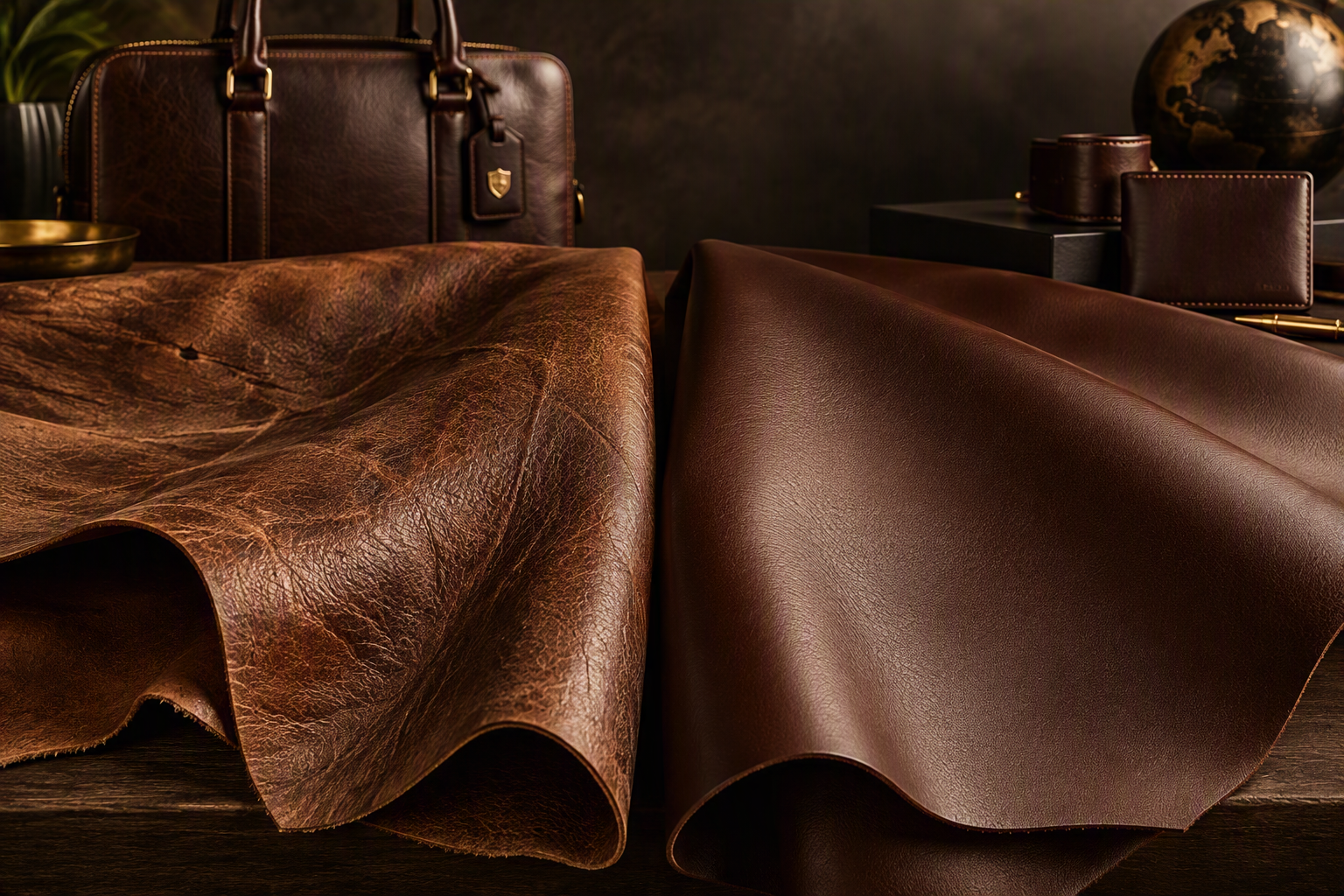
Confused by the difference between full-grain and top-grain leather? You're not alone. While these terms are often used as indicators of quality, the reality is more nuanced. In this guide, we explore how full-grain and top-grain leather are made, how they differ in appearance, durability, ageing and maintenance, and why neither material is automatically superior in every situation. Whether you're choosing a leather briefcase, business bag, wallet or belt, understanding the facts behind the terminology will help you make a more informed decision and appreciate the craftsmanship behind premium leather goods.
Full-grain and top-grain leather are often presented as the two highest positions in a simple leather-quality hierarchy. The reality is more nuanced.
Full-grain leather retains its complete natural grain surface without corrective mechanical removal. “Top-grain”, however, is used inconsistently. In everyday retail language, it commonly describes leather from the grain-bearing upper layer whose surface has been lightly sanded, buffed or otherwise corrected for greater uniformity. In some technical and American industry usage, top grain may instead mean the grain-bearing upper layer generally—and can even be treated as equivalent to full grain. The Leather Research Laboratory at the University of Cincinnati, for example, states that full-grain and top-grain leather are the same under the terminology it follows.
For buyers, the most useful question is therefore not simply, “Is this top-grain leather?” It is:
Does the leather retain its complete natural grain, or has the grain surface been corrected and refinished?
That distinction tells you more about how the leather may look, feel and age.
What Does “Grain” Mean in Leather?
The grain is the outer side of the hide revealed after the hair or wool and epidermis have been removed. Its natural pattern includes follicles and surface characteristics specific to the animal. When a hide is split horizontally, the upper section carrying this surface is the grain split, while lower layers are referred to as flesh or middle splits.
This is important because terms such as full grain, corrected grain and split leather describe the structure or treatment of the material. They do not, by themselves, provide a complete measure of quality.
A leather’s final performance is also influenced by:
the condition and selection of the original hide;
tanning and retanning;
thickness and fibre consistency;
dyeing and fatliquoring;
surface finishing;
resistance to flexing, abrasion, colour transfer and moisture;
the product’s pattern, reinforcement and construction; and
stitching, lining, edge finishing, hardware and workmanship.
The diagram below shows why full grain, corrected grain and split leather should not be treated as interchangeable terms.

Figure 1: A simplified hide cross-section showing the technical distinction between full-grain leather, corrected grain from the grain-bearing layer, and split leather from a lower layer. “Top-grain” is shown as an ambiguous commercial term that should be clarified with the supplier.
What Is Full-Grain Leather?
Leather Working Group defines full grain as leather that has kept its entire grain, with none of the surface removed by corrective mechanical treatment.leatherworkinggroup
This does not mean full-grain leather must be completely unfinished. It may still be dyed, oiled, waxed, lightly coated, pigmented or even embossed. What defines it is that the original grain has not been removed through corrective sanding, snuffing or buffing.
Because the natural surface remains, full-grain leather may show:
variations in grain pattern;
pores and wrinkles;
tonal differences;
healed scratches or scars; and
other characteristics associated with a natural hide.
These markings should not automatically be interpreted as faults. Their significance depends on location, depth, concentration and the intended product. Commercial leather grading may separately assess how much usable cutting area a hide provides, so full grain is not the same thing as first grade or A grade.
Full-grain leather is particularly suitable when a designer wants natural variation, tactile character and a surface that can evolve visibly with use. However, its precise ageing behaviour still depends on the tannage and finish.
What Is Top-Grain Leather?
This is where terminology becomes less consistent.
In popular consumer usage, top-grain leather usually means leather from the grain-bearing upper portion of the hide that has undergone some degree of surface refinement. Small irregularities may be sanded or buffed, after which colour, protective coatings or an embossed texture may be applied.
That treatment can create:
a smoother and more predictable appearance;
greater consistency between panels;
more controlled colour and texture; and
surface properties tailored to the product’s intended use.
However, top grain is not a sufficiently precise technical specification on its own. Some suppliers use it broadly for any leather from the upper, grain-bearing layer. Others use it as shorthand for corrected-grain leather. As noted above, the Leather Research Laboratory uses top grain as equivalent to full grain.
For accurate product descriptions, it is better to indicate whether the leather is:
full grain with the natural grain intact;
lightly corrected grain;
corrected grain with a pigmented finish;
nubuck, where the grain side is buffed to create a nap; or
split leather with an applied or coated surface.
What Is Corrected-Grain Leather?
Leather Working Group defines corrected grain as leather in which the grain has been partially removed by buffing or a similar mechanical treatment and then enhanced through finishing.
During correction, the surface is passed against an abrasive material to reduce small grain irregularities and create a more uniform base. A finishing system can then add colour, protection, texture or an embossed grain pattern. Technical guidance recommended by IULTCS and UNIDO explains that finishing can include coatings, binders, pigments, protective films, smoothing and embossing, all of which can affect the leather’s final appearance and physical properties.
Corrected grain should not automatically be considered poor leather. A carefully selected, appropriately corrected and well-finished leather can be highly suitable for premium products requiring a clean, consistent appearance. The extent and quality of the correction matter considerably.
Full-Grain vs Top-Grain Leather: Comparison
Swipe horizontally to view the full comparison.
| Characteristic | Full-Grain Leather | Top-Grain Leather in Common Retail Usage |
|---|---|---|
| Grain surface | Complete natural grain retained | Grain-bearing upper layer retained, but the surface may be lightly or substantially corrected |
| Surface treatment | No corrective mechanical removal | Often sanded, buffed, refinished or embossed |
| Appearance | More natural variation and visible character | Usually smoother and more visually consistent |
| Finishing options | May be aniline, semi-aniline, pigmented, waxed, oiled or otherwise finished | Commonly finished for consistency, colour control or protection |
| Patina | Often more visible with natural, aniline, waxed or pull-up finishes | May develop subtler surface character; heavily pigmented finishes usually change less visibly |
| Liquid and stain behaviour | Depends primarily on openness and finish, not the full-grain name alone | A protective finish may improve repellency, but performance depends on the actual finishing system |
| Maintenance | Natural or open-pore versions may require more cautious care | Pigmented or protected versions can be easier to clean |
| Consistency | Natural markings and tonal variation may remain | Correction can provide more uniform panels |
| Best suited to | Products designed to celebrate natural character and individual ageing | Refined products requiring controlled colour, texture and a polished appearance |
| Quality conclusion | Can be excellent, but the term alone does not guarantee construction or performance | Can also be premium; quality depends on hide selection, degree of correction, finish and manufacturing |
Which Is More Durable?
It is tempting to say that full-grain leather is always stronger and top-grain leather is always weaker. That is too simplistic.
Full-grain leather retains the complete original grain surface, whereas correction removes part of that surface. All other factors being equal, preserving more of the original structure is generally desirable for demanding, long-term use. But real products are rarely equal in every other respect.
A poorly tanned, unsuitable or badly constructed full-grain product may perform worse than an appropriately specified corrected-grain product. Thickness, fibre structure, finish flexibility, stitch resistance, reinforcement, edge construction and hardware can all influence service life.
The better buying questions are:
Is the leather appropriate for the product?
What finish has been applied?
Is the leather thick and firm enough—or soft and flexible enough—for its function?
Are high-stress areas reinforced?
Are the stitching, lining, zips and hardware of comparable quality?
Which Develops the Best Patina?
A patina is the gradual surface character produced through handling, light, friction, oils and use. It may include changes in colour, sheen and tonal depth.
Full-grain leather is often associated with patina because it is frequently paired with transparent aniline, waxed, oiled or pull-up finishes that allow natural changes to remain visible. However, patina is influenced as much by finishing as by grain classification.
Leather Naturally notes that aniline leather has no pigment finish, absorbs liquid more readily than pigmented leather and develops a distinctive patina over time. Pigmented leather has a more protective finish and better liquid repellency.
A lightly finished corrected-grain leather may still soften and gain character. A heavily pigmented or coated surface will generally retain a more consistent appearance, with the finish carrying much of the visible wear.
Which Handles Water and Stains Better?
Neither “full grain” nor “top grain” is a waterproof specification.
Water and stain behaviour depend heavily on:
whether the surface is open-pored or sealed;
whether the leather is aniline, semi-aniline or pigmented;
oils, waxes and water-repellent treatments;
coating thickness and finish quality; and
maintenance and exposure.
Pigmented finishes can provide good liquid repellency, while natural aniline surfaces absorb liquids more readily. Consequently, a protected corrected top-grain leather may be more forgiving in everyday commuting or business-travel conditions than an open-pore full-grain aniline leather.
That is a difference in finish performance, not proof that one grain category is universally more water resistant.
Is There a Universal Leather Grade Hierarchy?
No universal ladder ranks every leather as:
full grain;
top grain;
genuine leather; and
bonded leather.
That popular hierarchy mixes several different concepts.
Full grain and corrected grain describe surface condition.
Split leather describes a lower layer obtained by horizontally dividing a hide.
Aniline, semi-aniline and pigmented describe finishing approaches.
Vegetable, chrome and metal-free describe tanning systems.
A, B or first, second and third grade may describe commercial selection, defects or usable cutting yield.
Genuine leather generally confirms that real leather is present, but it does not identify a precise quality level.
Bonded leather fibre is a reconstituted material made from leather fibres and a binding system rather than an intact hide layer. Leather Working Group’s terminology requires this distinction.
A leather good should therefore be judged as a complete product rather than by one impressive-sounding word.
Full Grain, Genuine Leather, Split Leather and Faux Leather
Is “genuine leather” a grade?
Not reliably. “Genuine leather” generally distinguishes real leather from a synthetic alternative, but it does not tell you whether the material is full grain, corrected grain or split leather. Leather Naturally similarly describes genuine leather as a term used to emphasise that a product is natural leather rather than synthetic.
What is split leather?
Split leather is produced from a lower flesh or middle layer after a thick hide is divided horizontally. It does not retain the original natural grain surface. It may be used as suede or finished with a coating or applied texture.
What is bonded leather?
Bonded or recycled leather fibre is made by disintegrating leather into fibres or particles and reforming it with a binding agent. It is not the same structure as an intact full-grain, corrected-grain or split leather panel.leathernaturally
What is PU or faux leather?
PU and faux leather are synthetic or composite surface materials rather than animal-origin leather. They should be assessed according to their own composition and performance rather than placed within the full-grain versus top-grain comparison.
Which Leather Is Best for Briefcases, Bags, Belts and Wallets?
Briefcases and business bags
Full-grain leather suits briefcases designed to display natural texture and more individual ageing. Carefully selected top-grain or corrected-grain leather can be equally appropriate where the design calls for a polished silhouette, consistent colour, clean panels and practical surface protection.
This is why quality top-grain leather is often well suited to modern professional goods. Its value is not that it is “better” than full grain, but that a controlled surface can complement refined business design.
Travel bags
For travel, abrasion, handling, weather exposure, zips, lining, reinforcement and carrying comfort can matter as much as the grain description. A protected finish may offer practical benefits, while full grain may suit a design intended to acquire visible travel character.
Belts
Belts place repeated stress around holes, edges and the buckle fold. Grain type matters, but so do thickness, fibre density, whether the strap is solid or laminated, edge finishing and buckle construction.
Wallets and cardholders
Wallet leather must balance durability with controlled thickness. An excessively bulky leather can make folded construction impractical. Full grain can provide natural character, while refined top grain can produce a slimmer, cleaner and more consistent finish.
Why NORETI Uses Carefully Selected Top-Grain Leather
At NORETI, material selection begins with the intended product rather than a claim that one leather name is automatically superior.
Carefully selected top-grain leather can be a premium and practical choice for structured business and travel goods because it can combine natural leather character with the visual consistency required for clean panels and refined silhouettes. The result still depends on the quality of the hide, tanning, degree of surface correction, finish, thickness and colour consistency.
Just as importantly, the leather must be supported by considered construction: balanced pattern cutting, reliable stitching, finished edges, appropriate linings, strong attachment points and quality hardware. A material label alone cannot create a premium product.
How to Care for Full-Grain and Top-Grain Leather
Care should be based on the finish, not only the grain description.
Remove surface dust with a soft, dry cloth or suitable brush.
Avoid soaking leather or leaving it exposed to prolonged rain.
Allow wet leather to dry naturally, away from heaters, hairdryers and direct sunlight.
Use products formulated for the specific leather finish.
Test cleaners, conditioners and protectants on a hidden area first.
Treat open-pore aniline leather especially carefully, as it can darken or stain.
Avoid aggressive rubbing, which can damage colour or surface finishes.
Follow the product maker’s care instructions where available.
Leather Naturally recommends regular cleaning, appropriate protection for absorbent leather, natural drying and patch testing before applying a treatment.
Frequently Asked Questions
Is top-grain leather real leather?
Yes. In normal usage, top-grain leather refers to animal-origin leather from the grain-bearing upper layer. However, because the term is used inconsistently, ask whether its surface is full grain, lightly corrected or substantially corrected.
Is full-grain leather always better than top-grain leather?
No. Full grain is preferable when natural grain retention and visible ageing are priorities. Corrected top grain may be more suitable when consistency, a refined finish or specific surface performance is required.
Does full-grain leather always develop a patina?
Not to the same degree. Patina depends strongly on the tannage and finish. Aniline, waxed, oiled and pull-up full-grain leathers generally show more visible evolution than heavily pigmented versions.
Is top-grain leather good for a briefcase?
Yes. Well-selected top-grain leather can be an excellent choice for an executive briefcase, particularly when the design requires structured panels, controlled colour and a polished professional appearance.
Can full-grain leather have a coating?
Yes. Full grain describes whether the natural grain has been mechanically removed. It does not mean that no dye, pigment, protective finish or embossing can be applied. Technical leather-making guidance specifically illustrates full-grain leather with aniline, pigmented and embossed finishes.
How can I tell which leather is better when shopping online?
Look beyond the headline term. Check the leather layer, grain treatment, finish, thickness, construction, stitching, edge treatment, lining and hardware. If a description only states “premium leather” or “genuine leather”, ask for a more precise specification.
The Final Verdict
The clearest difference between full-grain and corrected top-grain leather is what happens to the natural grain surface.
Full-grain leather retains the complete original grain. Corrected-grain leather has part of that surface mechanically removed and rebuilt or enhanced through finishing. “Top-grain” may refer to corrected leather in retail usage, but its meaning should always be clarified.
Neither term evaluates the whole product. The appropriate choice depends on appearance, intended use, finish, maintenance expectations and construction.
For buyers who value natural variation and more visible ageing, full grain may be the preferred option. For those seeking a smooth, refined and consistent material for professional and travel goods, carefully selected top-grain leather can be a premium, practical choice.
Explore NORETI’s leather briefcases, business bags and accessories to see how considered materials, understated design and purposeful organisation come together in products created for modern work and travel.
NORETI™ | The Art of Distinction
*** Resources & Further Reading***
At NORETI, we believe informed ownership is part of true craftsmanship. The following resources provide additional information on leather terminology, grain classification, manufacturing, finishing, testing and care. They have been selected primarily from recognised standards organisations, technical laboratories and international leather-industry education bodies.
Leather Working Group — 74 Need-to-Know Leather Industry Terms
International Organization for Standardization — ISO 15115:2019 Leather Vocabulary
Leather Research Laboratory, University of Cincinnati — Full Grain & Top Grain
Leather Research Laboratory, University of Cincinnati — Corrected Grain Leather
IULTCS/UNIDO-recommended Making Leather Series — Application of the Finish