The Journal
Stories of Style, Design & Distinction
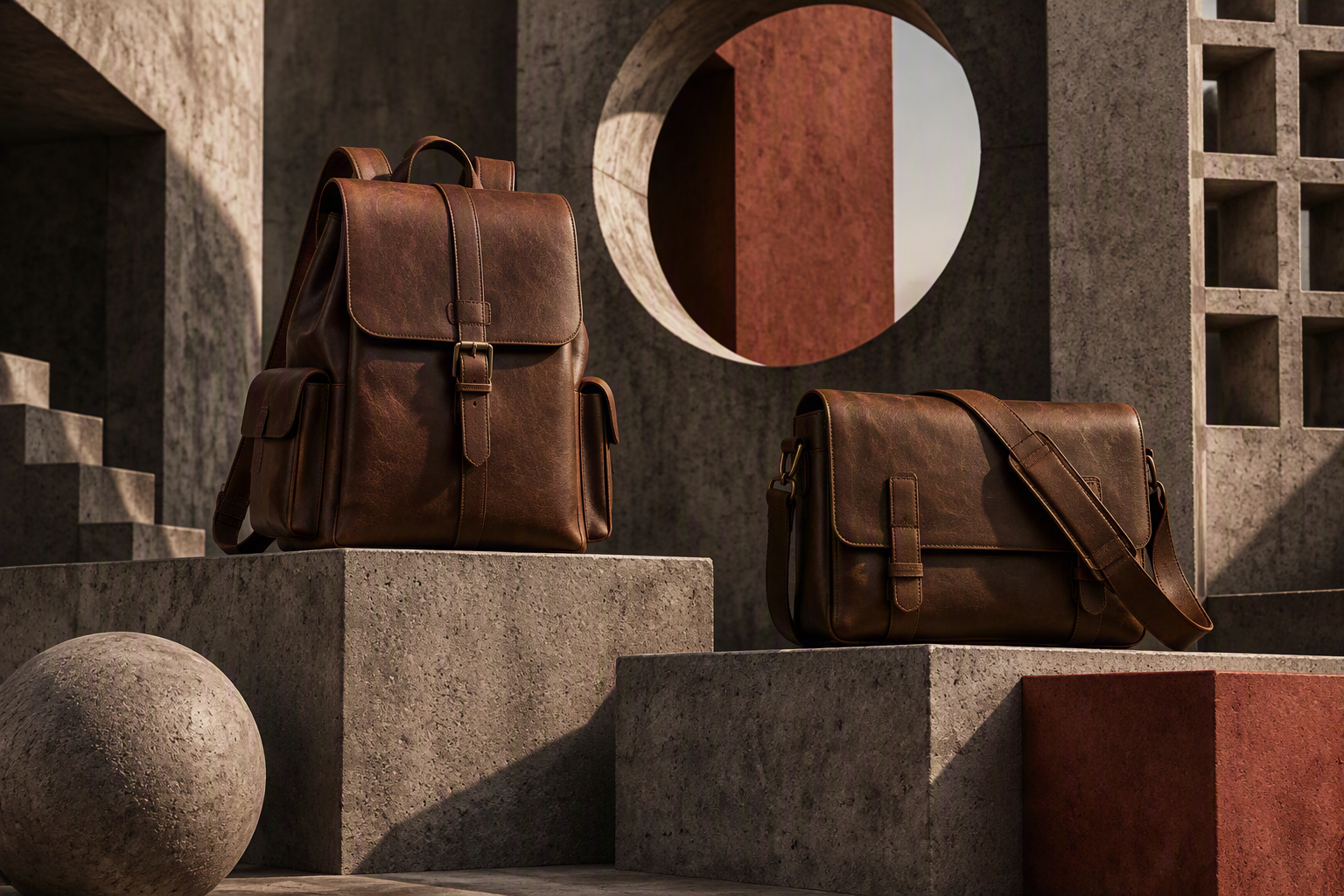
Leather Backpack vs Messenger Bag: Which Is Better for Work?
Leather backpack or messenger bag—which is better for work? We compare comfort, organisation, laptop storage, commuting, professional style and everyday practicality to help you choose the right work bag for your routine.
Choosing the best work bag is not simply a question of style. The right design should suit your commute, daily load, laptop size, workplace and preferred way of accessing your essentials.
In the leather backpack vs messenger bag comparison, neither format is universally better. A backpack generally distributes weight more symmetrically and offers greater capacity, while a messenger bag provides faster access and a slimmer, traditionally business-oriented profile.
For Australian professionals commuting by train, tram, bus, bicycle or on foot—and for international readers navigating similar working routines—the best choice depends on how the bag will actually be used.
The Short Answer: Backpack or Messenger Bag for Work?
A leather backpack is usually the more practical option if you:
Carry a laptop, charger, drink bottle, lunch and other daily essentials
Walk or cycle for part of your commute
Regularly travel between offices, airports or client locations
Prefer hands-free carrying
Need more capacity or internal organisation
A leather messenger bag may be more suitable if you:
Carry a relatively light load
Have a short commute
Frequently need access to documents, a phone or travel card
Prefer a slim bag that sits beside the body
Work in an environment where a more traditional business silhouette feels appropriate
The deciding factor should be your real working day—not simply how the bag looks when empty.
Comfort and Weight Distribution
The most important structural difference is how each bag carries weight.
A backpack uses two shoulder straps, allowing the load to be shared across both sides of the upper body. Research into load carriage generally supports symmetrical carrying when transporting meaningful weight, although comfort also depends on the total load, strap adjustment, bag fit and length of the journey.
A messenger bag is supported primarily by one shoulder, even when worn crossbody. This asymmetrical arrangement can require the body to compensate for the load. Small studies involving students and young adults have found differences in upper-back and shoulder muscle activity when comparing one-strap bags with two-strap backpacks.
These findings should not be treated as a medical guarantee that every backpack will be comfortable or every messenger bag will cause discomfort. A poorly fitted, overloaded backpack may still feel awkward, while a well-designed messenger bag can be entirely comfortable for carrying a light load over a short distance.
As a practical rule, the more you carry—and the longer you carry it—the more valuable balanced weight distribution becomes.
Which Is Better for Commuting?
For longer walks, cycling or multi-stage public transport journeys, a work backpack often has the practical advantage. It keeps both hands free and usually remains more stable while moving.
That can be useful when holding a train rail, carrying coffee, checking a phone or moving through a station. A backpack may also provide enough space for an extra layer, umbrella or lunch without requiring a second bag.
However, backpacks have disadvantages. They normally need to be removed before the main compartment can be opened. They can also feel warm against the back, particularly during active commutes or hot weather. Larger backpacks may be inconvenient in crowded carriages unless removed and carried by the top handle.
A messenger bag offers easier access while standing or walking. It can be moved from the hip to the front of the body without being fully removed, making it convenient for reaching a wallet, access pass, notebook or headphones.
For short urban commutes with a light everyday carry, that accessibility may be more useful than the additional capacity of a backpack.
Laptop Protection and Device Transport
Both formats can serve as a professional laptop bag, but the word “messenger” can describe anything from a compact crossbody bag to a full-size laptop satchel. Always check the internal dimensions rather than relying on the product category alone.
A good work laptop bag should hold the device securely without excessive movement. Useful features include:
A dedicated padded laptop compartment
A secure closure
Separation between the laptop and items such as keys or charging plugs
Space for the charger, mouse and cables
A structured base or protective lower section
A compartment sized for the actual laptop, including its thickness
Backpacks often separate technology, documents and personal items across several sections. This can be helpful for professionals carrying a laptop, tablet, cables and other work equipment.
Within NORETI’s range, the Valen Signature Executive Backpack is an example of this work-and-travel approach. Its listed features include a protected compartment for laptops up to 15.6 inches, multi-compartment organisation, expandable storage and a luggage strap. These features illustrate the type of details worth assessing in any professional backpack, regardless of brand.
Messenger bags commonly provide one broad laptop section alongside pockets for documents and smaller accessories. Their horizontal shape can make notebooks and folders easier to view, but a heavily loaded messenger may become uncomfortable during a long walk.
Access and Organisation
Accessibility is one of the messenger bag’s clearest strengths. A crossbody messenger can usually be moved to the front, opened and returned to the side in one motion.
This can suit people who frequently move through building security, use public transport cards, take notes between meetings or need quick access to documents.
Backpacks usually provide greater organisational capacity. Multiple compartments can separate technology, personal items, food and travel accessories. The trade-off is that too many pockets can add bulk and make it harder to remember where smaller items have been placed.
The best organisation system is not necessarily the one with the most compartments. It is the one that gives frequently used items a logical, accessible place while keeping heavier objects stable and close to the body.
Professional Appearance and Workplace Style
Professional appearance is subjective and varies between industries, workplaces and individual dress styles.
A leather messenger bag has a low, horizontal profile that can complement tailored clothing, business-casual outfits and meeting-focused roles. Its resemblance to a traditional satchel or soft briefcase may suit workplaces where structure and formality remain important.
A leather backpack can appear equally refined when it has a clean silhouette, restrained hardware and an organised shape. In contemporary offices, creative industries, technology roles, universities and hybrid workplaces, a well-designed business backpack is unlikely to feel out of place.
If your working week includes both formal meetings and active commuting, consider which environment presents the greater practical demand. It may be more sensible to choose for the commute and keep the design understated than to choose solely for the meeting room.
Capacity: How Much Do You Really Carry?
Before selecting a work bag for professionals, lay out everything you normally carry:
Laptop and charger
Phone and wallet
Notebook or documents
Headphones
Drink bottle
Lunch
Umbrella
Personal care items
Gym clothing or a light jacket
If these items create a dense or bulky load, a backpack will usually accommodate them more easily. If your everyday carry consists mainly of a slim laptop, charger, phone and notebook, a messenger bag may provide enough room without unnecessary volume.
Avoid buying substantially more capacity than you need. Extra space often encourages overpacking, while an oversized bag can feel cumbersome even when it is not full.
Business Travel and Airport Use
A leather backpack is generally more versatile for professionals who travel regularly. It leaves both hands available for luggage and can offer separate spaces for technology, documents and personal items. A luggage pass-through or rear strap can also allow the bag to sit over a compatible suitcase handle.
A messenger bag can work well as a compact personal item for short business trips, particularly when fast access to a passport, boarding pass and laptop is important. It may also fit neatly beneath an aircraft seat, depending on its dimensions.
Airline cabin-bag limits differ, so compare the bag’s external measurements with the requirements of the airline operating your journey.
Leather-Specific Considerations
Leather can give both backpacks and messenger bags a polished appearance, but the material influences practical performance.
Some leather bags are relatively heavy before anything is packed. Empty weight matters because a laptop, charger and drink bottle can quickly increase the total carrying load. Compare the bag’s listed weight as carefully as its dimensions.
Also consider how the leather, lining, hardware and closures suit your routine. A daily commuter bag may experience rain, crowded transport, floor contact and repeated opening. Check the manufacturer’s care guidance and water-resistance claims rather than assuming that all leather offers the same protection.
How to Choose the Best Work Bag
Use these questions to make the decision:
How long do I carry the bag?
Longer walks generally favour the balanced carry of a backpack.How heavy is my normal load?
A laptop plus several accessories may be more comfortable in a two-strap design.How often do I need access while moving?
Frequent access favours a messenger bag.What size is my laptop?
Check internal compartment measurements, not only the advertised screen size.Do I commute actively?
Walking and cycling generally favour a stable, hands-free backpack.How formal is my workplace?
A messenger may complement traditional business clothing, while a minimalist leather backpack can suit many modern professional settings.Do I travel for work?
Consider organised technology storage, secure closures and suitcase compatibility.
Final Verdict: Which Is Better for Work?
For comfort, capacity and longer commuting, a leather backpack is often the stronger all-round work bag. Its two-strap design distributes the load more symmetrically, while its storage format can accommodate technology, documents and personal essentials.
For lighter loads, quick access and a slimmer business profile, a leather messenger bag may be the better choice. It works particularly well for short commutes, meetings and professionals who carry only the essentials.
The best work bag is therefore not the one that wins every comparison. It is the one that fits your laptop, supports your usual load, works with your commute and feels appropriate in the environments where you spend your day.
Resources & Further Reading
At NORETI, we believe informed ownership is part of true craftsmanship. The following resources provide additional information on leather terminology, grain classification, manufacturing, finishing, testing and care. They have been selected primarily from recognised standards organisations, technical laboratories and international leather-industry education bodies.
NORETI — Valen Signature Executive Backpack, product information, Amazon Australia: https://www.amazon.com.au/NORETI-Valen-Signature-Executive-Backpack/dp/B0HLKT3P5N
Healthdirect Australia — How to Improve Your Posture: https://www.healthdirect.gov.au/healthy-living/physical-activity/how-to-improve-your-posture
Safe Work Australia — Lifting, Pushing and Pulling: Manual Tasks: https://www.safeworkaustralia.gov.au/safety-topic/hazards/lifting-pushing-and-pulling-manual-tasks
WorkSafe Victoria — Hazardous Manual Handling: Safety Basics: https://www.worksafe.vic.gov.au/hazardous-manual-handling-safety-basics
Genitrini, M., Dotti, F., Bianca, E. and Ferri, A. — Impact of Backpacks on Ergonomics: Biomechanical and Physiological Effects, International Journal of Environmental Research and Public Health: https://doi.org/10.3390/ijerph19116737
Hardie, R., Haskew, R., Harris, J. and Hughes, G. — The Effects of Bag Style on Muscle Activity During Walking, Journal of Human Kinetics: https://doi.org/10.1515/hukin-2015-0005
Yoon, J-G. — Correlations Between Muscle Activities and Strap Length and Types of School Bag During Walking, Journal of Physical Therapy Science: https://doi.org/10.1589/jpts.26.1937
Rodrigues, F.B. et al. — Effects of Backpack Load and Positioning on Nonlinear Gait Features in Young Adults, Ergonomics: https://doi.org/10.1080/00140139.2017.1413213