The Journal
Stories of Style, Design & Distinction

Do You Really Need a Laptop Sleeve? Protection, Fit & Everyday Benefits
Do you really need a laptop sleeve if you already have a backpack? Discover how laptop sleeves help protect against scratches, what to look for in a proper fit, and whether a leather laptop sleeve is worth buying.
A laptop has become an essential part of modern life. From early morning commutes and client meetings to university lectures, cafés and international travel, our devices move with us almost everywhere.
Yet while considerable thought goes into choosing the right laptop, the question of how to carry it is often overlooked.
Do you really need a laptop sleeve, especially if you already own a backpack or laptop bag?
The answer depends on how you use and transport your device, the protection your existing bag provides, and whether you value a more streamlined way to carry your technology.
A well-chosen laptop sleeve can help protect against everyday scratches, surface wear and minor bumps. It also provides a dedicated layer between your laptop and the other objects you carry.
However, not every sleeve offers the same protection, and a sleeve should never be mistaken for a shockproof case.
In this guide, we explore the practical benefits of laptop sleeves, when they are worth using, how they compare with laptop bags, and what to consider when choosing a refined leather laptop sleeve for everyday use.
Do You Need a Laptop Sleeve? The Short Answer
A laptop sleeve is worth considering if you frequently carry your laptop between locations, store it alongside other belongings, or want additional protection against everyday scratches and light contact.
You may benefit from using a laptop sleeve if you:
Carry your laptop inside a backpack without a dedicated protective compartment.
Regularly move between home, the office, meetings and shared workspaces.
Want to prevent keys, chargers and other objects from rubbing against your laptop.
Prefer a slim, lightweight alternative to a conventional laptop bag.
Travel regularly and want to keep your device separate from other belongings.
Value a professional, minimalist way to carry your laptop.
However, a sleeve may be unnecessary if your existing bag already has a well-fitted, sufficiently padded laptop compartment and you rarely transport your device.
The important distinction is that a laptop sleeve provides an additional layer of protection, not complete protection against accidental damage.
What Is a Laptop Sleeve?
A laptop sleeve is a slim, close-fitting cover designed to hold a laptop or tablet without the bulk of a traditional carrying case.
Unlike a laptop backpack or briefcase, which typically accommodates chargers, documents and personal belongings, a laptop sleeve focuses primarily on the device itself.
Laptop sleeves are available in a variety of materials, including:
Neoprene: Flexible, lightweight and commonly used for cushioned sleeves.
Polyester and nylon: Practical textile materials available in numerous constructions and finishes.
Felt: Soft and minimalist, although protection depends on thickness and construction.
Genuine leather: A refined option valued for its natural texture, character and professional appearance.
Structured synthetic materials: Often used in cases designed to provide additional rigidity.
Some sleeves include substantial foam padding, reinforced corners or water-resistant coatings. Others prioritise slimness, elegance and protection from everyday surface contact.
The best choice depends on whether your priority is impact protection, minimal bulk, material quality or a combination of these qualities.
5 Benefits of Using a Laptop Sleeve
1. Protection Against Scratches and Everyday Wear
Even when handled carefully, a laptop can gradually develop scratches and marks through everyday transportation.
Keys, charging adapters, metal pens and other hard objects can come into contact with its exterior when placed in the same compartment.
A properly fitted laptop sleeve creates a physical barrier between the device and surrounding belongings.
This can help reduce:
Surface scratches on the laptop casing.
Scuff marks from repeated contact with other items.
Friction against rough bag linings.
Minor cosmetic wear during regular transportation.
For professionals who regularly move between offices, vehicles and meetings, this simple separation can be particularly useful.
Although a sleeve cannot guarantee that a device will remain pristine, it can help preserve its exterior condition over time.
2. An Additional Layer Against Minor Bumps
A laptop can experience small knocks when a bag is placed on a desk, moved into an overhead compartment or carried through a crowded commute.
A sleeve with appropriate cushioning may help absorb some of the force associated with light everyday contact.
However, the degree of protection varies significantly between designs.
A thin leather sleeve, for example, may provide effective separation from abrasive surfaces without offering the same impact cushioning as a thick, padded protective case.
If your laptop is regularly exposed to demanding travel conditions or an increased risk of being dropped, choose a sleeve or carrying case specifically designed with impact protection in mind.
A laptop sleeve is not a substitute for careful handling or a properly constructed protective bag.
3. Extra Protection Inside a Backpack
One of the most common questions is whether a laptop sleeve is necessary when you already carry a backpack.
The answer depends largely on the backpack's internal design.
Some everyday backpacks have a spacious main compartment but no dedicated laptop section. In these bags, your computer may move against books, accessories and other belongings.
A laptop sleeve can help keep the device separated and reduce direct contact with surrounding objects.
Even when a backpack includes a laptop compartment, a sleeve may offer added scratch protection and make it easier to remove the laptop for use elsewhere.
For professionals who regularly switch between a backpack, briefcase and travel bag, a separate sleeve also provides a consistent way to carry the device.
4. A Slimmer Alternative to a Laptop Bag
Not everyone needs a full-size laptop bag for every occasion.
You may simply be moving from your desk to a meeting room, visiting a nearby café or travelling between floors of the same building.
For these situations, carrying an entire backpack can feel unnecessary.
A slim laptop sleeve provides a more compact solution.
It allows you to carry your computer without the additional size of multiple pockets, shoulder straps and large compartments.
A refined leather design can also complement professional clothing, making it suitable for office environments and client-facing settings.
The appeal is straightforward: carry what you need, without unnecessary bulk.
5. A More Considered Way to Carry Your Technology
Practicality is important, but the objects we use every day also contribute to our personal style.
A laptop is often carried into meetings, placed on conference tables or taken into professional environments where appearance matters.
A carefully selected laptop sleeve can create a more coordinated and intentional presentation.
Black leather offers a restrained, contemporary appearance, while darker brown tones can complement traditional business accessories.
For those who prefer understated design, a minimalist leather laptop sleeve can feel more appropriate than an oversized technology bag.
At NORETI, we believe useful objects should also reflect thoughtful craftsmanship and individual distinction.
Do You Need a Laptop Sleeve if You Have a Backpack?
Not necessarily.
If your backpack already includes a secure, appropriately sized, padded laptop compartment, an additional sleeve may provide only a modest practical benefit.
However, a sleeve becomes more valuable when the backpack lacks adequate internal separation or when the laptop is regularly removed and carried independently.
Before deciding, examine your backpack's laptop storage.
Ask yourself:
Does the laptop sit securely without excessive movement?
Is there sufficient padding around the device?
Is the laptop separated from chargers, keys and other hard objects?
Does the bottom of the compartment provide protection when the bag is placed on the ground?
Is the compartment protected from nearby drink bottles or potential spills?
If several of these features are missing, adding a sleeve may be worthwhile.
For everyday commuting, a combination of a well-designed backpack and a properly fitted sleeve can offer useful flexibility.
The backpack provides carrying comfort and storage capacity, while the sleeve keeps the laptop more securely separated from other belongings.
Laptop Sleeve vs Laptop Bag: What's the Difference?
Although the terms are sometimes used interchangeably, laptop sleeves and laptop bags are designed for different purposes.
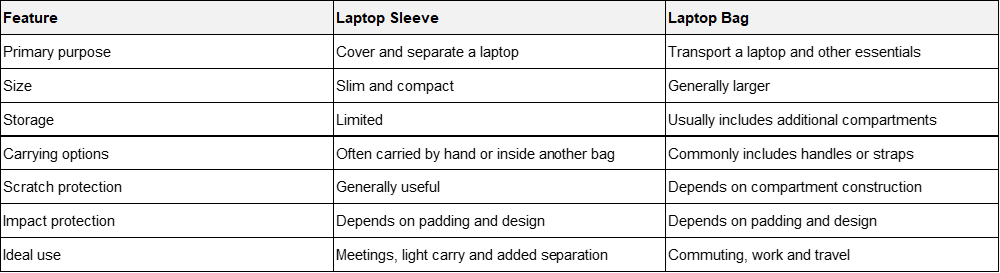
A laptop sleeve is often the better option when simplicity and portability are priorities.
A laptop bag becomes more practical when you regularly carry chargers, documents, headphones, notebooks and other essentials.
For many people, the most useful solution is not choosing one over the other, but using both when the situation requires it.
How to Choose the Right Laptop Sleeve Size
One of the most important considerations when purchasing a laptop sleeve is fit.
An incorrectly sized sleeve may allow excessive movement or place unwanted pressure on the device.
Don't Rely on Screen Size Alone
Laptop sizes are commonly advertised in inches, such as 13-inch, 14-inch, 15-inch or 16-inch.
However, these measurements usually refer to the diagonal display size, not the external dimensions of the entire laptop.
Two laptops advertised as 14-inch models may have noticeably different body dimensions because of their bezels, thickness and overall construction.
This means a sleeve marketed for a 14-inch laptop will not necessarily fit every 14-inch device.
Measure Your Laptop Correctly
Before purchasing, check three measurements:
Width: The external measurement from one side of the laptop to the other.
Depth: The external measurement from the front edge to the back.
Thickness: The height of the laptop when closed.
Compare these measurements with the sleeve's usable internal dimensions rather than relying exclusively on its advertised size.
Remember that external sleeve dimensions may include seams, folds and other construction details that reduce the available interior space.
Should a Laptop Sleeve Be Tight or Loose?
A laptop sleeve should fit snugly enough to limit unnecessary movement while allowing the device to be inserted and removed comfortably.
An excessively tight fit may put pressure on the laptop or make the sleeve difficult to use.
An oversized sleeve may allow the laptop to shift during transportation.
The ideal fit is secure without requiring force.
When in doubt, confirm the product's internal dimensions and compatibility guidance before purchasing.
Are Leather Laptop Sleeves Worth It?
A leather laptop sleeve can be a worthwhile choice for someone who values natural materials, understated design and a professional appearance.
Unlike many conventional fabric sleeves, leather offers a distinctive surface texture and visual character.
Depending on the leather type, finish and use, it may also develop subtle changes in colour and appearance over time.
However, leather should not automatically be considered more protective than other sleeve materials.
A padded textile sleeve may provide better cushioning against impacts than a thin, unpadded leather design.
The advantages of a leather sleeve are often found in the balance between practicality, material character and aesthetics.
What to Look for in a Quality Leather Laptop Sleeve
When comparing leather laptop sleeves, pay attention to:
Leather selection: Consider the type, finish and suitability of the leather.
Interior construction: Look for materials and seams that will not scratch the device.
Fit: Confirm compatibility with your laptop's external measurements.
Edge finishing: Check whether edges are neatly finished and comfortable to handle.
Closure design: Ensure the laptop remains appropriately secured.
Protective construction: Assess padding and reinforcement separately from appearance.
Everyday practicality: Consider whether the sleeve fits inside your existing work bag.
Premium materials are valuable, but the complete construction determines how well a sleeve performs in everyday use.
Introducing the Valmont Leather Laptop Sleeve by NORETI
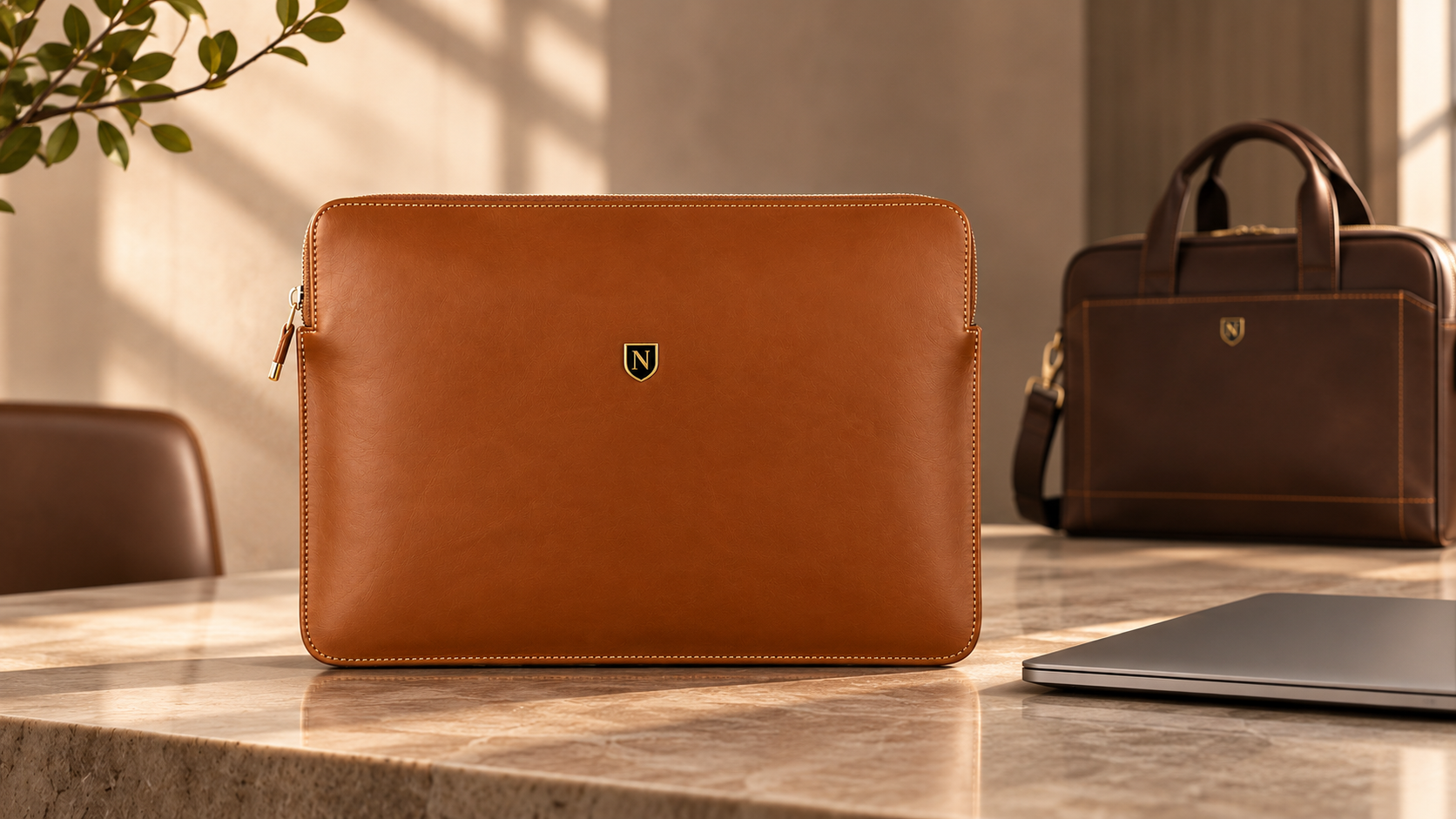
For those seeking a refined approach to carrying their technology, the NORETI Valmont Leather Laptop Sleeve combines a minimalist silhouette with the natural character of genuine leather.
Crafted from selected top-layer genuine leather, Valmont features an envelope-inspired design, clean lines and understated NORETI shield detailing.
Its slim profile is intended to complement professional and everyday settings without the bulk of a conventional laptop bag.
Designed for many laptops and tablets up to approximately 14 inches, Valmont measures approximately 35.5 × 25.6 × 2 cm.
Its close-fitting construction makes it suitable for carrying independently between meetings or placing inside a compatible briefcase, backpack or travel bag.
Available in three timeless finishes:
Black: Minimalist, contemporary and effortlessly professional.
Dark Coffee: Deep, understated and well suited to classic business accessories.
Cognac Brown: Warm and distinctive, with a naturally expressive appearance.
Beyond laptop storage, its streamlined format also lends itself to carrying slim documents and notebooks.
As with any laptop sleeve, compatibility depends on the device's actual dimensions. The Valmont should be selected for its intended everyday use rather than treated as a drop-proof or waterproof protective case.
Explore the NORETI Leather Laptop Sleeve Collection to discover the Valmont range.
Can a Laptop Sleeve Protect Against Water Damage?
A laptop sleeve may offer limited separation from light moisture, but most standard sleeves should not be considered waterproof.
Protection depends on the material, seams, openings, closure and any water-resistant treatment.
A leather laptop sleeve, in particular, should not be exposed unnecessarily to heavy rain or prolonged moisture.
If you regularly commute in wet conditions, consider using a bag with verified weather-resistant construction and a secure closure.
Keep liquids in a separate compartment and avoid placing a laptop directly beside an unsealed drink bottle.
If a leather sleeve becomes wet, follow the manufacturer's care instructions and allow it to dry naturally away from direct heat.
A laptop sleeve should never be relied upon as the sole defence against liquid damage.
How to Care for a Leather Laptop Sleeve
Proper care can help preserve the appearance and condition of a leather laptop sleeve.
Start with a few straightforward habits.
Keep the surface clean. Remove loose dust using a soft, dry cloth. Avoid abrasive cleaning materials.
Limit moisture exposure. Do not soak the leather or expose it unnecessarily to rain.
Avoid excessive heat. Keep the sleeve away from radiators, heaters and prolonged direct sunlight.
Use appropriate leather-care products. Different finishes require different treatments. Test any recommended product on an inconspicuous area before applying it more broadly.
Avoid overloading. Do not force bulky chargers or accessories into a sleeve designed primarily for a laptop.
Store thoughtfully. When not in use, keep the sleeve in a clean, dry environment without heavy objects placed on top.
Regular, appropriate care is generally more beneficial than aggressive cleaning or excessive conditioning.
Frequently Asked Questions About Laptop Sleeves
Is a laptop sleeve necessary?
A laptop sleeve is not essential for everyone. It is particularly useful when carrying a laptop inside an unpadded bag, transporting it frequently or seeking additional protection against scratches and everyday contact.
If your existing laptop compartment already provides sufficient protection, a sleeve may be optional.
Do laptop sleeves actually protect laptops?
Yes, laptop sleeves can help reduce scratches, scuffs and contact with surrounding objects.
Padded sleeves may also provide some cushioning against minor bumps.
However, protection varies by design, and no ordinary laptop sleeve should be assumed to prevent damage from a significant drop.
Should I use a laptop sleeve inside a backpack?
Using a laptop sleeve inside a backpack can be beneficial when the bag lacks a dedicated padded compartment or when the laptop shares space with other items.
If the backpack already provides adequate padding and separation, the additional benefit may be smaller.
Is it safe to carry a laptop without a sleeve?
Yes, provided the laptop is transported carefully in a suitable protective compartment or case.
A sleeve is an optional accessory rather than a requirement for safe laptop ownership.
Can a 14-inch laptop fit in a 13-inch sleeve?
Not necessarily.
Screen-size labels do not provide enough information to establish compatibility.
Always compare the laptop's external width, depth and thickness with the sleeve's usable interior dimensions.
Is a leather laptop sleeve better than neoprene?
Neither material is universally better.
Leather may appeal to buyers seeking natural texture, a professional appearance and timeless styling.
Neoprene sleeves can offer flexible cushioning and lightweight practicality.
The better choice depends on the sleeve's construction and your personal priorities.
Can I carry a laptop in a sleeve without a bag?
Yes. A suitably designed sleeve can be convenient for short movements between rooms, offices and meetings.
For longer commutes, heavy accessories or demanding travel conditions, a protective laptop bag may be more practical.
Do laptop sleeves help prevent overheating?
A laptop sleeve is intended for transportation and storage, not temperature control.
Avoid using a laptop while it remains inside a sleeve unless the device and sleeve manufacturers explicitly permit it. Covering ventilation areas may interfere with cooling.
Final Verdict: Is a Laptop Sleeve Worth Buying?
For many laptop owners, a sleeve is a simple accessory that can make everyday transportation more considered and convenient.
It helps keep a device separated from surrounding belongings, reduces direct contact with potentially abrasive surfaces and provides a streamlined option for moving between workspaces.
Its value becomes particularly clear for people who commute regularly, carry their laptop in different bags or prefer a minimalist approach to everyday essentials.
Yet a laptop sleeve is not necessary in every situation.
The right choice depends on the protection already provided by your bag, the way you transport your device and the level of impact resistance you require.
A well-chosen sleeve should fit correctly, suit your routine and complement the way you work.
For those who appreciate the natural character of leather and the elegance of understated design, a carefully crafted leather laptop sleeve offers something beyond simple practicality.
It transforms an everyday object into a considered part of your professional essentials.
Because true distinction is often found in the details.
NORETI™ — The Art of Distinction.
Further Reading & References
HP — How to Choose a Laptop Bag: Sleeves, Backpacks and Sizing — Guidance on the different protective functions of laptop sleeves, cases and bags.
NORETI — Backpack vs Briefcase: Which Is Better for Work? — Comparing professional bag styles, laptop compartments, commuting and everyday organisation.
The NORETI Journal — Further guides to leather quality, work accessories, travel and considered design.

Leather Backpack vs Messenger Bag: Which Is Better for Work?
Leather backpack or messenger bag—which is better for work? We compare comfort, organisation, laptop storage, commuting, professional style and everyday practicality to help you choose the right work bag for your routine.
Choosing the best work bag is not simply a question of style. The right design should suit your commute, daily load, laptop size, workplace and preferred way of accessing your essentials.
In the leather backpack vs messenger bag comparison, neither format is universally better. A backpack generally distributes weight more symmetrically and offers greater capacity, while a messenger bag provides faster access and a slimmer, traditionally business-oriented profile.
For Australian professionals commuting by train, tram, bus, bicycle or on foot—and for international readers navigating similar working routines—the best choice depends on how the bag will actually be used.
The Short Answer: Backpack or Messenger Bag for Work?
A leather backpack is usually the more practical option if you:
Carry a laptop, charger, drink bottle, lunch and other daily essentials
Walk or cycle for part of your commute
Regularly travel between offices, airports or client locations
Prefer hands-free carrying
Need more capacity or internal organisation
A leather messenger bag may be more suitable if you:
Carry a relatively light load
Have a short commute
Frequently need access to documents, a phone or travel card
Prefer a slim bag that sits beside the body
Work in an environment where a more traditional business silhouette feels appropriate
The deciding factor should be your real working day—not simply how the bag looks when empty.
Comfort and Weight Distribution
The most important structural difference is how each bag carries weight.
A backpack uses two shoulder straps, allowing the load to be shared across both sides of the upper body. Research into load carriage generally supports symmetrical carrying when transporting meaningful weight, although comfort also depends on the total load, strap adjustment, bag fit and length of the journey.
A messenger bag is supported primarily by one shoulder, even when worn crossbody. This asymmetrical arrangement can require the body to compensate for the load. Small studies involving students and young adults have found differences in upper-back and shoulder muscle activity when comparing one-strap bags with two-strap backpacks.
These findings should not be treated as a medical guarantee that every backpack will be comfortable or every messenger bag will cause discomfort. A poorly fitted, overloaded backpack may still feel awkward, while a well-designed messenger bag can be entirely comfortable for carrying a light load over a short distance.
As a practical rule, the more you carry—and the longer you carry it—the more valuable balanced weight distribution becomes.
Which Is Better for Commuting?
For longer walks, cycling or multi-stage public transport journeys, a work backpack often has the practical advantage. It keeps both hands free and usually remains more stable while moving.
That can be useful when holding a train rail, carrying coffee, checking a phone or moving through a station. A backpack may also provide enough space for an extra layer, umbrella or lunch without requiring a second bag.
However, backpacks have disadvantages. They normally need to be removed before the main compartment can be opened. They can also feel warm against the back, particularly during active commutes or hot weather. Larger backpacks may be inconvenient in crowded carriages unless removed and carried by the top handle.
A messenger bag offers easier access while standing or walking. It can be moved from the hip to the front of the body without being fully removed, making it convenient for reaching a wallet, access pass, notebook or headphones.
For short urban commutes with a light everyday carry, that accessibility may be more useful than the additional capacity of a backpack.
Laptop Protection and Device Transport
Both formats can serve as a professional laptop bag, but the word “messenger” can describe anything from a compact crossbody bag to a full-size laptop satchel. Always check the internal dimensions rather than relying on the product category alone.
A good work laptop bag should hold the device securely without excessive movement. Useful features include:
A dedicated padded laptop compartment
A secure closure
Separation between the laptop and items such as keys or charging plugs
Space for the charger, mouse and cables
A structured base or protective lower section
A compartment sized for the actual laptop, including its thickness
Backpacks often separate technology, documents and personal items across several sections. This can be helpful for professionals carrying a laptop, tablet, cables and other work equipment.
Within NORETI’s range, the Valen Signature Executive Backpack is an example of this work-and-travel approach. Its listed features include a protected compartment for laptops up to 15.6 inches, multi-compartment organisation, expandable storage and a luggage strap. These features illustrate the type of details worth assessing in any professional backpack, regardless of brand.
Messenger bags commonly provide one broad laptop section alongside pockets for documents and smaller accessories. Their horizontal shape can make notebooks and folders easier to view, but a heavily loaded messenger may become uncomfortable during a long walk.
Access and Organisation
Accessibility is one of the messenger bag’s clearest strengths. A crossbody messenger can usually be moved to the front, opened and returned to the side in one motion.
This can suit people who frequently move through building security, use public transport cards, take notes between meetings or need quick access to documents.
Backpacks usually provide greater organisational capacity. Multiple compartments can separate technology, personal items, food and travel accessories. The trade-off is that too many pockets can add bulk and make it harder to remember where smaller items have been placed.
The best organisation system is not necessarily the one with the most compartments. It is the one that gives frequently used items a logical, accessible place while keeping heavier objects stable and close to the body.
Professional Appearance and Workplace Style
Professional appearance is subjective and varies between industries, workplaces and individual dress styles.
A leather messenger bag has a low, horizontal profile that can complement tailored clothing, business-casual outfits and meeting-focused roles. Its resemblance to a traditional satchel or soft briefcase may suit workplaces where structure and formality remain important.
A leather backpack can appear equally refined when it has a clean silhouette, restrained hardware and an organised shape. In contemporary offices, creative industries, technology roles, universities and hybrid workplaces, a well-designed business backpack is unlikely to feel out of place.
If your working week includes both formal meetings and active commuting, consider which environment presents the greater practical demand. It may be more sensible to choose for the commute and keep the design understated than to choose solely for the meeting room.
Capacity: How Much Do You Really Carry?
Before selecting a work bag for professionals, lay out everything you normally carry:
Laptop and charger
Phone and wallet
Notebook or documents
Headphones
Drink bottle
Lunch
Umbrella
Personal care items
Gym clothing or a light jacket
If these items create a dense or bulky load, a backpack will usually accommodate them more easily. If your everyday carry consists mainly of a slim laptop, charger, phone and notebook, a messenger bag may provide enough room without unnecessary volume.
Avoid buying substantially more capacity than you need. Extra space often encourages overpacking, while an oversized bag can feel cumbersome even when it is not full.
Business Travel and Airport Use
A leather backpack is generally more versatile for professionals who travel regularly. It leaves both hands available for luggage and can offer separate spaces for technology, documents and personal items. A luggage pass-through or rear strap can also allow the bag to sit over a compatible suitcase handle.
A messenger bag can work well as a compact personal item for short business trips, particularly when fast access to a passport, boarding pass and laptop is important. It may also fit neatly beneath an aircraft seat, depending on its dimensions.
Airline cabin-bag limits differ, so compare the bag’s external measurements with the requirements of the airline operating your journey.
Leather-Specific Considerations
Leather can give both backpacks and messenger bags a polished appearance, but the material influences practical performance.
Some leather bags are relatively heavy before anything is packed. Empty weight matters because a laptop, charger and drink bottle can quickly increase the total carrying load. Compare the bag’s listed weight as carefully as its dimensions.
Also consider how the leather, lining, hardware and closures suit your routine. A daily commuter bag may experience rain, crowded transport, floor contact and repeated opening. Check the manufacturer’s care guidance and water-resistance claims rather than assuming that all leather offers the same protection.
How to Choose the Best Work Bag
Use these questions to make the decision:
How long do I carry the bag?
Longer walks generally favour the balanced carry of a backpack.How heavy is my normal load?
A laptop plus several accessories may be more comfortable in a two-strap design.How often do I need access while moving?
Frequent access favours a messenger bag.What size is my laptop?
Check internal compartment measurements, not only the advertised screen size.Do I commute actively?
Walking and cycling generally favour a stable, hands-free backpack.How formal is my workplace?
A messenger may complement traditional business clothing, while a minimalist leather backpack can suit many modern professional settings.Do I travel for work?
Consider organised technology storage, secure closures and suitcase compatibility.
Final Verdict: Which Is Better for Work?
For comfort, capacity and longer commuting, a leather backpack is often the stronger all-round work bag. Its two-strap design distributes the load more symmetrically, while its storage format can accommodate technology, documents and personal essentials.
For lighter loads, quick access and a slimmer business profile, a leather messenger bag may be the better choice. It works particularly well for short commutes, meetings and professionals who carry only the essentials.
The best work bag is therefore not the one that wins every comparison. It is the one that fits your laptop, supports your usual load, works with your commute and feels appropriate in the environments where you spend your day.
Resources & Further Reading
At NORETI, we believe informed ownership is part of true craftsmanship. The following resources provide additional information on leather terminology, grain classification, manufacturing, finishing, testing and care. They have been selected primarily from recognised standards organisations, technical laboratories and international leather-industry education bodies.
NORETI — Valen Signature Executive Backpack, product information, Amazon Australia: https://www.amazon.com.au/NORETI-Valen-Signature-Executive-Backpack/dp/B0HLKT3P5N
Healthdirect Australia — How to Improve Your Posture: https://www.healthdirect.gov.au/healthy-living/physical-activity/how-to-improve-your-posture
Safe Work Australia — Lifting, Pushing and Pulling: Manual Tasks: https://www.safeworkaustralia.gov.au/safety-topic/hazards/lifting-pushing-and-pulling-manual-tasks
WorkSafe Victoria — Hazardous Manual Handling: Safety Basics: https://www.worksafe.vic.gov.au/hazardous-manual-handling-safety-basics
Genitrini, M., Dotti, F., Bianca, E. and Ferri, A. — Impact of Backpacks on Ergonomics: Biomechanical and Physiological Effects, International Journal of Environmental Research and Public Health: https://doi.org/10.3390/ijerph19116737
Hardie, R., Haskew, R., Harris, J. and Hughes, G. — The Effects of Bag Style on Muscle Activity During Walking, Journal of Human Kinetics: https://doi.org/10.1515/hukin-2015-0005
Yoon, J-G. — Correlations Between Muscle Activities and Strap Length and Types of School Bag During Walking, Journal of Physical Therapy Science: https://doi.org/10.1589/jpts.26.1937
Rodrigues, F.B. et al. — Effects of Backpack Load and Positioning on Nonlinear Gait Features in Young Adults, Ergonomics: https://doi.org/10.1080/00140139.2017.1413213