The Journal
Stories of Style, Design & Distinction
Do You Really Need a Laptop Sleeve? Protection, Fit & Everyday Benefits
Do you really need a laptop sleeve if you already have a backpack? Discover how laptop sleeves help protect against scratches, what to look for in a proper fit, and whether a leather laptop sleeve is worth buying.
A laptop has become an essential part of modern life. From early morning commutes and client meetings to university lectures, cafés and international travel, our devices move with us almost everywhere.
Yet while considerable thought goes into choosing the right laptop, the question of how to carry it is often overlooked.
Do you really need a laptop sleeve, especially if you already own a backpack or laptop bag?
The answer depends on how you use and transport your device, the protection your existing bag provides, and whether you value a more streamlined way to carry your technology.
A well-chosen laptop sleeve can help protect against everyday scratches, surface wear and minor bumps. It also provides a dedicated layer between your laptop and the other objects you carry.
However, not every sleeve offers the same protection, and a sleeve should never be mistaken for a shockproof case.
In this guide, we explore the practical benefits of laptop sleeves, when they are worth using, how they compare with laptop bags, and what to consider when choosing a refined leather laptop sleeve for everyday use.
Do You Need a Laptop Sleeve? The Short Answer
A laptop sleeve is worth considering if you frequently carry your laptop between locations, store it alongside other belongings, or want additional protection against everyday scratches and light contact.
You may benefit from using a laptop sleeve if you:
Carry your laptop inside a backpack without a dedicated protective compartment.
Regularly move between home, the office, meetings and shared workspaces.
Want to prevent keys, chargers and other objects from rubbing against your laptop.
Prefer a slim, lightweight alternative to a conventional laptop bag.
Travel regularly and want to keep your device separate from other belongings.
Value a professional, minimalist way to carry your laptop.
However, a sleeve may be unnecessary if your existing bag already has a well-fitted, sufficiently padded laptop compartment and you rarely transport your device.
The important distinction is that a laptop sleeve provides an additional layer of protection, not complete protection against accidental damage.
What Is a Laptop Sleeve?
A laptop sleeve is a slim, close-fitting cover designed to hold a laptop or tablet without the bulk of a traditional carrying case.
Unlike a laptop backpack or briefcase, which typically accommodates chargers, documents and personal belongings, a laptop sleeve focuses primarily on the device itself.
Laptop sleeves are available in a variety of materials, including:
Neoprene: Flexible, lightweight and commonly used for cushioned sleeves.
Polyester and nylon: Practical textile materials available in numerous constructions and finishes.
Felt: Soft and minimalist, although protection depends on thickness and construction.
Genuine leather: A refined option valued for its natural texture, character and professional appearance.
Structured synthetic materials: Often used in cases designed to provide additional rigidity.
Some sleeves include substantial foam padding, reinforced corners or water-resistant coatings. Others prioritise slimness, elegance and protection from everyday surface contact.
The best choice depends on whether your priority is impact protection, minimal bulk, material quality or a combination of these qualities.
5 Benefits of Using a Laptop Sleeve
1. Protection Against Scratches and Everyday Wear
Even when handled carefully, a laptop can gradually develop scratches and marks through everyday transportation.
Keys, charging adapters, metal pens and other hard objects can come into contact with its exterior when placed in the same compartment.
A properly fitted laptop sleeve creates a physical barrier between the device and surrounding belongings.
This can help reduce:
Surface scratches on the laptop casing.
Scuff marks from repeated contact with other items.
Friction against rough bag linings.
Minor cosmetic wear during regular transportation.
For professionals who regularly move between offices, vehicles and meetings, this simple separation can be particularly useful.
Although a sleeve cannot guarantee that a device will remain pristine, it can help preserve its exterior condition over time.
2. An Additional Layer Against Minor Bumps
A laptop can experience small knocks when a bag is placed on a desk, moved into an overhead compartment or carried through a crowded commute.
A sleeve with appropriate cushioning may help absorb some of the force associated with light everyday contact.
However, the degree of protection varies significantly between designs.
A thin leather sleeve, for example, may provide effective separation from abrasive surfaces without offering the same impact cushioning as a thick, padded protective case.
If your laptop is regularly exposed to demanding travel conditions or an increased risk of being dropped, choose a sleeve or carrying case specifically designed with impact protection in mind.
A laptop sleeve is not a substitute for careful handling or a properly constructed protective bag.
3. Extra Protection Inside a Backpack
One of the most common questions is whether a laptop sleeve is necessary when you already carry a backpack.
The answer depends largely on the backpack's internal design.
Some everyday backpacks have a spacious main compartment but no dedicated laptop section. In these bags, your computer may move against books, accessories and other belongings.
A laptop sleeve can help keep the device separated and reduce direct contact with surrounding objects.
Even when a backpack includes a laptop compartment, a sleeve may offer added scratch protection and make it easier to remove the laptop for use elsewhere.
For professionals who regularly switch between a backpack, briefcase and travel bag, a separate sleeve also provides a consistent way to carry the device.
4. A Slimmer Alternative to a Laptop Bag
Not everyone needs a full-size laptop bag for every occasion.
You may simply be moving from your desk to a meeting room, visiting a nearby café or travelling between floors of the same building.
For these situations, carrying an entire backpack can feel unnecessary.
A slim laptop sleeve provides a more compact solution.
It allows you to carry your computer without the additional size of multiple pockets, shoulder straps and large compartments.
A refined leather design can also complement professional clothing, making it suitable for office environments and client-facing settings.
The appeal is straightforward: carry what you need, without unnecessary bulk.
5. A More Considered Way to Carry Your Technology
Practicality is important, but the objects we use every day also contribute to our personal style.
A laptop is often carried into meetings, placed on conference tables or taken into professional environments where appearance matters.
A carefully selected laptop sleeve can create a more coordinated and intentional presentation.
Black leather offers a restrained, contemporary appearance, while darker brown tones can complement traditional business accessories.
For those who prefer understated design, a minimalist leather laptop sleeve can feel more appropriate than an oversized technology bag.
At NORETI, we believe useful objects should also reflect thoughtful craftsmanship and individual distinction.
Do You Need a Laptop Sleeve if You Have a Backpack?
Not necessarily.
If your backpack already includes a secure, appropriately sized, padded laptop compartment, an additional sleeve may provide only a modest practical benefit.
However, a sleeve becomes more valuable when the backpack lacks adequate internal separation or when the laptop is regularly removed and carried independently.
Before deciding, examine your backpack's laptop storage.
Ask yourself:
Does the laptop sit securely without excessive movement?
Is there sufficient padding around the device?
Is the laptop separated from chargers, keys and other hard objects?
Does the bottom of the compartment provide protection when the bag is placed on the ground?
Is the compartment protected from nearby drink bottles or potential spills?
If several of these features are missing, adding a sleeve may be worthwhile.
For everyday commuting, a combination of a well-designed backpack and a properly fitted sleeve can offer useful flexibility.
The backpack provides carrying comfort and storage capacity, while the sleeve keeps the laptop more securely separated from other belongings.
Laptop Sleeve vs Laptop Bag: What's the Difference?
Although the terms are sometimes used interchangeably, laptop sleeves and laptop bags are designed for different purposes.
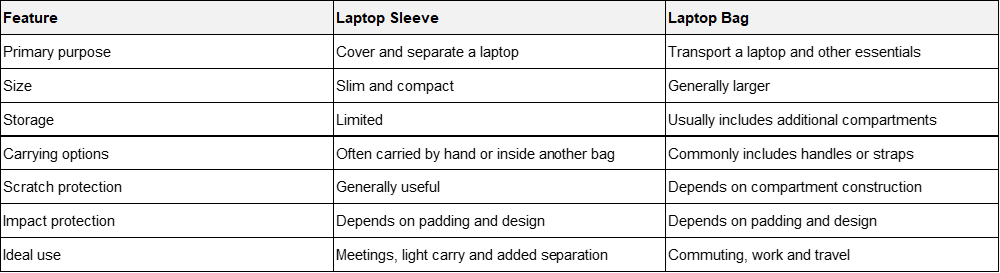
A laptop sleeve is often the better option when simplicity and portability are priorities.
A laptop bag becomes more practical when you regularly carry chargers, documents, headphones, notebooks and other essentials.
For many people, the most useful solution is not choosing one over the other, but using both when the situation requires it.
How to Choose the Right Laptop Sleeve Size
One of the most important considerations when purchasing a laptop sleeve is fit.
An incorrectly sized sleeve may allow excessive movement or place unwanted pressure on the device.
Don't Rely on Screen Size Alone
Laptop sizes are commonly advertised in inches, such as 13-inch, 14-inch, 15-inch or 16-inch.
However, these measurements usually refer to the diagonal display size, not the external dimensions of the entire laptop.
Two laptops advertised as 14-inch models may have noticeably different body dimensions because of their bezels, thickness and overall construction.
This means a sleeve marketed for a 14-inch laptop will not necessarily fit every 14-inch device.
Measure Your Laptop Correctly
Before purchasing, check three measurements:
Width: The external measurement from one side of the laptop to the other.
Depth: The external measurement from the front edge to the back.
Thickness: The height of the laptop when closed.
Compare these measurements with the sleeve's usable internal dimensions rather than relying exclusively on its advertised size.
Remember that external sleeve dimensions may include seams, folds and other construction details that reduce the available interior space.
Should a Laptop Sleeve Be Tight or Loose?
A laptop sleeve should fit snugly enough to limit unnecessary movement while allowing the device to be inserted and removed comfortably.
An excessively tight fit may put pressure on the laptop or make the sleeve difficult to use.
An oversized sleeve may allow the laptop to shift during transportation.
The ideal fit is secure without requiring force.
When in doubt, confirm the product's internal dimensions and compatibility guidance before purchasing.
Are Leather Laptop Sleeves Worth It?
A leather laptop sleeve can be a worthwhile choice for someone who values natural materials, understated design and a professional appearance.
Unlike many conventional fabric sleeves, leather offers a distinctive surface texture and visual character.
Depending on the leather type, finish and use, it may also develop subtle changes in colour and appearance over time.
However, leather should not automatically be considered more protective than other sleeve materials.
A padded textile sleeve may provide better cushioning against impacts than a thin, unpadded leather design.
The advantages of a leather sleeve are often found in the balance between practicality, material character and aesthetics.
What to Look for in a Quality Leather Laptop Sleeve
When comparing leather laptop sleeves, pay attention to:
Leather selection: Consider the type, finish and suitability of the leather.
Interior construction: Look for materials and seams that will not scratch the device.
Fit: Confirm compatibility with your laptop's external measurements.
Edge finishing: Check whether edges are neatly finished and comfortable to handle.
Closure design: Ensure the laptop remains appropriately secured.
Protective construction: Assess padding and reinforcement separately from appearance.
Everyday practicality: Consider whether the sleeve fits inside your existing work bag.
Premium materials are valuable, but the complete construction determines how well a sleeve performs in everyday use.
Introducing the Valmont Leather Laptop Sleeve by NORETI
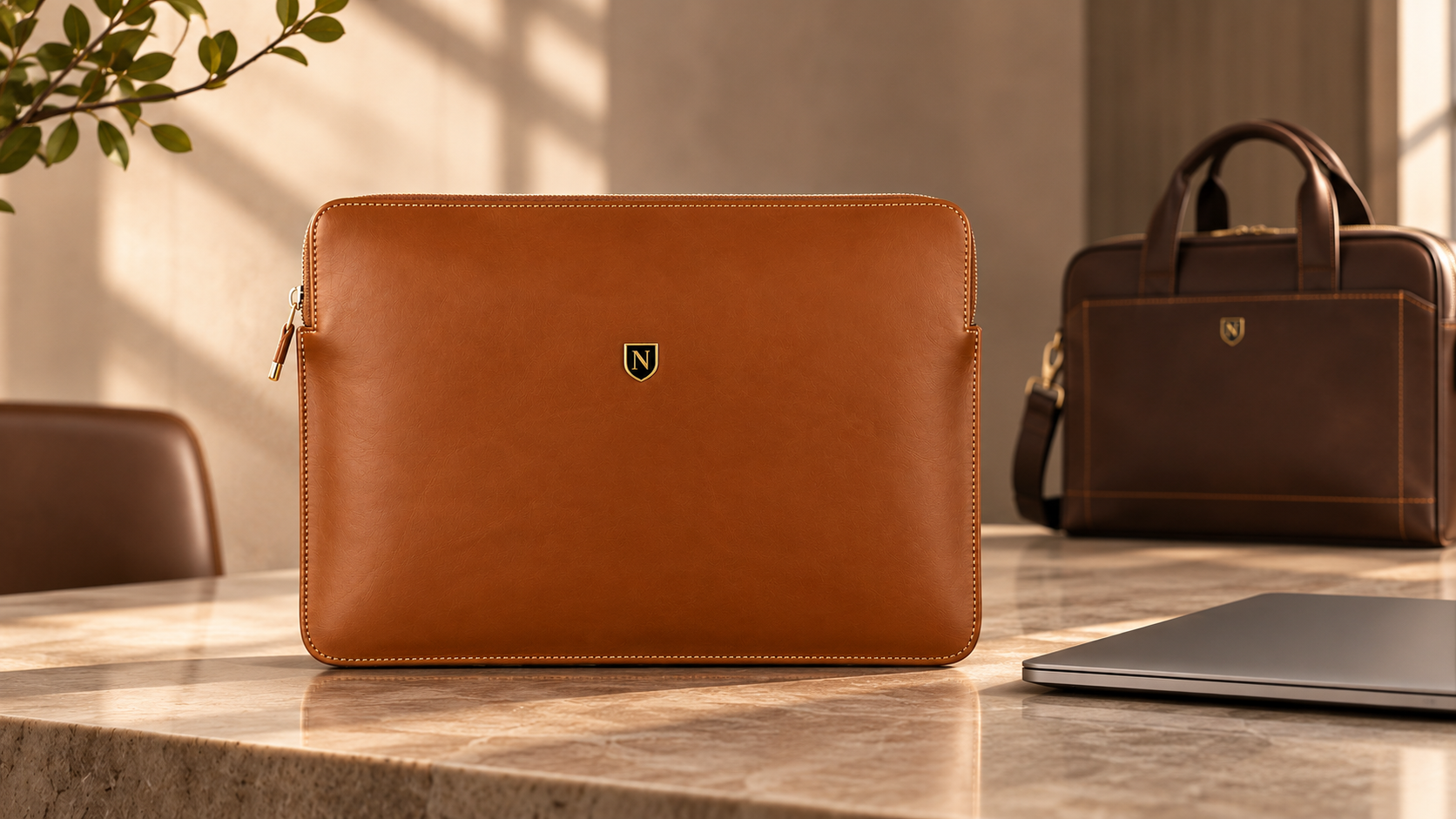
For those seeking a refined approach to carrying their technology, the NORETI Valmont Leather Laptop Sleeve combines a minimalist silhouette with the natural character of genuine leather.
Crafted from selected top-layer genuine leather, Valmont features an envelope-inspired design, clean lines and understated NORETI shield detailing.
Its slim profile is intended to complement professional and everyday settings without the bulk of a conventional laptop bag.
Designed for many laptops and tablets up to approximately 14 inches, Valmont measures approximately 35.5 × 25.6 × 2 cm.
Its close-fitting construction makes it suitable for carrying independently between meetings or placing inside a compatible briefcase, backpack or travel bag.
Available in three timeless finishes:
Black: Minimalist, contemporary and effortlessly professional.
Dark Coffee: Deep, understated and well suited to classic business accessories.
Cognac Brown: Warm and distinctive, with a naturally expressive appearance.
Beyond laptop storage, its streamlined format also lends itself to carrying slim documents and notebooks.
As with any laptop sleeve, compatibility depends on the device's actual dimensions. The Valmont should be selected for its intended everyday use rather than treated as a drop-proof or waterproof protective case.
Explore the NORETI Leather Laptop Sleeve Collection to discover the Valmont range.
Can a Laptop Sleeve Protect Against Water Damage?
A laptop sleeve may offer limited separation from light moisture, but most standard sleeves should not be considered waterproof.
Protection depends on the material, seams, openings, closure and any water-resistant treatment.
A leather laptop sleeve, in particular, should not be exposed unnecessarily to heavy rain or prolonged moisture.
If you regularly commute in wet conditions, consider using a bag with verified weather-resistant construction and a secure closure.
Keep liquids in a separate compartment and avoid placing a laptop directly beside an unsealed drink bottle.
If a leather sleeve becomes wet, follow the manufacturer's care instructions and allow it to dry naturally away from direct heat.
A laptop sleeve should never be relied upon as the sole defence against liquid damage.
How to Care for a Leather Laptop Sleeve
Proper care can help preserve the appearance and condition of a leather laptop sleeve.
Start with a few straightforward habits.
Keep the surface clean. Remove loose dust using a soft, dry cloth. Avoid abrasive cleaning materials.
Limit moisture exposure. Do not soak the leather or expose it unnecessarily to rain.
Avoid excessive heat. Keep the sleeve away from radiators, heaters and prolonged direct sunlight.
Use appropriate leather-care products. Different finishes require different treatments. Test any recommended product on an inconspicuous area before applying it more broadly.
Avoid overloading. Do not force bulky chargers or accessories into a sleeve designed primarily for a laptop.
Store thoughtfully. When not in use, keep the sleeve in a clean, dry environment without heavy objects placed on top.
Regular, appropriate care is generally more beneficial than aggressive cleaning or excessive conditioning.
Frequently Asked Questions About Laptop Sleeves
Is a laptop sleeve necessary?
A laptop sleeve is not essential for everyone. It is particularly useful when carrying a laptop inside an unpadded bag, transporting it frequently or seeking additional protection against scratches and everyday contact.
If your existing laptop compartment already provides sufficient protection, a sleeve may be optional.
Do laptop sleeves actually protect laptops?
Yes, laptop sleeves can help reduce scratches, scuffs and contact with surrounding objects.
Padded sleeves may also provide some cushioning against minor bumps.
However, protection varies by design, and no ordinary laptop sleeve should be assumed to prevent damage from a significant drop.
Should I use a laptop sleeve inside a backpack?
Using a laptop sleeve inside a backpack can be beneficial when the bag lacks a dedicated padded compartment or when the laptop shares space with other items.
If the backpack already provides adequate padding and separation, the additional benefit may be smaller.
Is it safe to carry a laptop without a sleeve?
Yes, provided the laptop is transported carefully in a suitable protective compartment or case.
A sleeve is an optional accessory rather than a requirement for safe laptop ownership.
Can a 14-inch laptop fit in a 13-inch sleeve?
Not necessarily.
Screen-size labels do not provide enough information to establish compatibility.
Always compare the laptop's external width, depth and thickness with the sleeve's usable interior dimensions.
Is a leather laptop sleeve better than neoprene?
Neither material is universally better.
Leather may appeal to buyers seeking natural texture, a professional appearance and timeless styling.
Neoprene sleeves can offer flexible cushioning and lightweight practicality.
The better choice depends on the sleeve's construction and your personal priorities.
Can I carry a laptop in a sleeve without a bag?
Yes. A suitably designed sleeve can be convenient for short movements between rooms, offices and meetings.
For longer commutes, heavy accessories or demanding travel conditions, a protective laptop bag may be more practical.
Do laptop sleeves help prevent overheating?
A laptop sleeve is intended for transportation and storage, not temperature control.
Avoid using a laptop while it remains inside a sleeve unless the device and sleeve manufacturers explicitly permit it. Covering ventilation areas may interfere with cooling.
Final Verdict: Is a Laptop Sleeve Worth Buying?
For many laptop owners, a sleeve is a simple accessory that can make everyday transportation more considered and convenient.
It helps keep a device separated from surrounding belongings, reduces direct contact with potentially abrasive surfaces and provides a streamlined option for moving between workspaces.
Its value becomes particularly clear for people who commute regularly, carry their laptop in different bags or prefer a minimalist approach to everyday essentials.
Yet a laptop sleeve is not necessary in every situation.
The right choice depends on the protection already provided by your bag, the way you transport your device and the level of impact resistance you require.
A well-chosen sleeve should fit correctly, suit your routine and complement the way you work.
For those who appreciate the natural character of leather and the elegance of understated design, a carefully crafted leather laptop sleeve offers something beyond simple practicality.
It transforms an everyday object into a considered part of your professional essentials.
Because true distinction is often found in the details.
NORETI™ — The Art of Distinction.
Further Reading & References
HP — How to Choose a Laptop Bag: Sleeves, Backpacks and Sizing — Guidance on the different protective functions of laptop sleeves, cases and bags.
NORETI — Backpack vs Briefcase: Which Is Better for Work? — Comparing professional bag styles, laptop compartments, commuting and everyday organisation.
The NORETI Journal — Further guides to leather quality, work accessories, travel and considered design.

The History of Leather: A 5,500-Year Journey of Craftsmanship
Journey through 5,500 years of leather history, from an extraordinary discovery in ancient Armenia to the origins of tanning and modern luxury craftsmanship. Discover how leather became one of the world's most enduring materials.
From an ancient cave in Armenia to the refined leather goods of today, discover the remarkable history of one of humanity's most enduring materials.
Some materials are defined by fashion. Others are defined by time.
Leather belongs to the latter.
Long before the existence of luxury fashion houses, modern cities or the concept of designer accessories, our ancestors had already discovered the remarkable potential of animal hides.
What began as a practical means of protection would eventually become one of the most recognisable materials in the history of craftsmanship.
Its story is one of human ingenuity, ancient civilisations and a pursuit of refinement that has endured for thousands of years.
And one of its most extraordinary chapters begins in a quiet cave in Armenia.
A Discovery Hidden for 5,500 Years
In 2008, archaeologists exploring the Areni-1 cave complex in Armenia uncovered something extraordinary.
Hidden beneath layers of history was a remarkably preserved leather shoe, dating to approximately 3500 BC.
It was not an elaborate object of wealth or status.
It was a simple piece of footwear, fashioned from a single piece of leather and shaped to protect the human foot.
Yet its significance was profound.
The discovery provided direct evidence of sophisticated leatherworking more than five millennia ago.
Its carefully constructed form revealed something remarkably familiar: even in prehistoric times, people understood the importance of selecting, shaping and working materials to meet everyday needs.
Thousands of years before modern leather workshops, the fundamental relationship between material, function and craftsmanship was already taking shape.
The story of leather was never simply about what people carried or wore. It was about what they could create.
Where Did Leather Originally Come From?
The origins of leather stretch much further back than the Armenian discovery.
Early humans used animal skins for warmth, shelter and protection. Over time, they developed methods of cleaning, softening and preserving hides, transforming a perishable natural material into something more useful.
These early techniques gradually evolved into leatherworking and tanning traditions.
Unlike untreated hides, properly processed leather could offer greater flexibility, durability and resistance to deterioration.
This transformation represented an important technological achievement.
A natural material that might otherwise decay could become clothing, footwear, containers and equipment designed for repeated use.
There is no single known inventor of leather.
Its development was the result of generations of experimentation across different cultures and regions.
What emerged was not merely a material, but an enduring craft.
Ancient Egypt: When Leather Became an Art
As civilisations developed, so did their understanding of leather.
In ancient Egypt, leather was used for sandals, belts, bags, furniture, shields and ceremonial objects.
Archaeological discoveries reveal that Egyptian craftspeople also explored colour, surface decoration and techniques for preparing animal hides.
Leather was no longer valued solely for its practicality.
It became a medium through which skill, appearance and purpose could meet.
Imagine the workshops of ancient Egypt: craftspeople preparing hides, working surfaces, shaping pieces and creating objects intended for daily life.
Every finished piece required an understanding of the material.
Its thickness. Its flexibility. Its strength. Its intended purpose.
These considerations remain central to quality leather goods today.
Although the tools and production techniques have changed considerably, the importance of understanding the material has not.
The Art of Tanning: Transforming Hide Into Leather
At the heart of leather's history lies one of its most important developments: tanning.
Tanning is the process of treating animal hides to improve their stability and resistance to decomposition.
Across history, craftspeople developed different methods using natural fats, oils, plant materials and mineral substances.
One particularly important tradition is vegetable tanning.
This process uses tannins found in botanical sources, such as tree bark and other plant materials, to transform hides into leather.
Vegetable-tanned leather remains appreciated for its distinctive characteristics and its potential to develop a rich patina through use.
Modern leather production also includes other tanning methods, each producing different properties and finishes.
Understanding these distinctions helps explain why genuine leather products can vary so significantly in texture, appearance, flexibility and performance.
The character of leather is shaped not only by nature, but by the way the material is prepared.
From Ancient Utility to Luxury Leather Goods
Over the centuries, leather became increasingly important in commerce, transportation, clothing and personal accessories.
Travellers relied on leather bags and pouches to carry their belongings.
Artisans produced belts, footwear and protective equipment.
As leatherworking traditions developed, decorative techniques and increasingly refined construction methods expanded what could be achieved with the material.
Eventually, leather became closely associated with fine luggage, sophisticated handbags, leather briefcases and luxury accessories.
Its appeal extended beyond practical durability.
People came to appreciate the richness of its texture, the precision of its construction and the individuality of its appearance.
The finest leather goods demonstrated how a functional object could also become an expression of personal taste.
This relationship between utility and elegance remains fundamental to contemporary leather design.
Why Leather Still Matters in Modern Luxury
In a world defined by rapidly changing trends, leather continues to hold a distinctive place in fashion and design.
Part of its appeal lies in its versatility.
A structured leather briefcase can communicate quiet professionalism.
A carefully designed leather wallet can bring refinement to an everyday essential.
A leather travel bag can combine practical organisation with an understated sense of style.
Different types of leather also offer their own characteristics.
Full-grain leather retains the natural grain surface of the hide, while top-grain leather may undergo additional finishing to achieve a particular appearance.
Depending on the material and its treatment, leather can develop subtle changes in colour, texture and character over time.
These qualities help explain why leather has remained relevant across generations.
But the value of a leather accessory cannot be judged by its material alone.
Thoughtful proportions, secure stitching, appropriate hardware and careful finishing are equally important.
True craftsmanship is found in how these elements work together.
A New Chapter: Leather and Contemporary Design
The modern world offers a wider range of materials and manufacturing techniques than ever before.
Alongside traditional genuine leather, premium vegan leather alternatives have become part of contemporary accessory design.
Each material presents different possibilities in appearance, texture, care and construction.
For the modern customer, the most important consideration is not simply tradition, but making an informed choice.
At NORETI, we appreciate both the heritage of genuine leather and the possibilities offered by thoughtfully selected modern materials.
Our approach to premium leather goods and accessories is guided by considered design, functionality and understated sophistication.
We believe that an accessory should complement the life of its owner rather than compete for attention.
It should feel purposeful.
It should be beautifully proportioned.
And its details should reward a closer look.
From an Ancient Cave to the Modern Wardrobe
Consider the journey.
More than 5,500 years ago, someone shaped a piece of leather into a shoe.
Today, leather is used to create refined briefcases, elegant handbags, wallets and accessories carried around the world.
The distance between these two moments is extraordinary.
Yet they share a simple idea: materials become meaningful through human creativity and skill.
The tools have evolved. The designs have changed. The possibilities have expanded.
But the appreciation for thoughtful craftsmanship remains.
Perhaps that is the most remarkable part of leather's story.
Not simply that the material has survived for thousands of years, but that people have continued to find new ways to give it purpose.
Frequently Asked Questions About the History of Leather
When was leather first invented?
There is no established date for the invention of leather. Humans used and processed animal hides in prehistoric times, long before written records. Archaeological discoveries provide evidence of ancient leatherworking traditions.
What is the oldest known leather shoe?
The Areni-1 leather shoe, discovered in Armenia in 2008 and dating to approximately 3500 BC, is among the oldest known examples of preserved leather footwear.
Which ancient civilisation first used leather?
Leather and animal-hide processing developed in prehistoric societies. Ancient Egypt and Mesopotamia provide important archaeological evidence of early leatherworking, but neither can definitively be identified as its sole origin.
How was leather made in ancient times?
Ancient craftspeople used methods including drying, cleaning, softening and treating hides with fats, oils, plant materials and other substances. Techniques varied across cultures and historical periods.
Why is leather associated with luxury?
Leather's natural characteristics, versatility and long association with skilled craftsmanship have contributed to its place in luxury fashion and accessories. Material selection, design and construction determine the quality of the finished product.
The Art of Distinction
The history of leather reminds us that meaningful design is rarely separated from the past.
Every material has a story.
Every craft has an origin.
And every thoughtfully created object becomes part of a continuing tradition.
At NORETI, we draw inspiration from this enduring appreciation for materials, purpose and refined craftsmanship.
Because true luxury is not simply about what we own.
It is about the thought behind what we choose.
NORETI — The Art of Distinction.
Explore the NORETI collection of premium leather bags, business accessories and contemporary travel essentials.
Historical sources and accuracy
The article is an original retelling, not a copied historical text. These sources support its central historical claims:
The peer-reviewed archaeological study documenting the Areni-1 leather shoe and its dating. PMC
University College London research documenting ancient Egyptian leather bags, footwear and decorated leather objects. University College London
Museum and conservation resources explaining historical hide preservation and tanning practices. Development Services

How to Tell if a Leather Bag Is Real: 7 Signs of Quality
Discover how to tell if a leather bag is real with seven essential signs of quality. From natural grain and texture to stitching and craftsmanship, learn how to identify genuine leather, recognise premium materials and choose a luxury leather bag with confidence.
A practical guide to recognising genuine leather, understanding craftsmanship and choosing a bag designed to stand the test of time.
A beautiful leather bag is more than an accessory. It is a reflection of personal style, considered design and an appreciation for quality.
Yet with countless products described as genuine leather, premium leather or luxury leather, knowing what you are actually buying can be surprisingly difficult.
Modern synthetic materials can closely imitate the appearance and texture of natural leather, making it challenging to distinguish between the two at first glance.
So, how can you tell if a leather bag is real?
The answer lies in understanding seven important characteristics, from natural grain and texture to material construction and craftsmanship.
1. Examine the Leather Grain and Surface Texture
One of the first places to look is the surface of the leather.
Natural leather often displays subtle variations in grain, pores and texture. These characteristics originate from the animal hide and can create a distinctive appearance.
Depending on how the leather has been processed, you may notice:
Slight variations in surface grain.
Natural creases and irregularities.
Differences in texture across the material.
Small natural markings or scars.
Synthetic leather may feature an unusually consistent embossed pattern, particularly across large surfaces.
However, consistency alone does not mean a bag is fake. Genuine leather can be corrected, embossed or finished to create a uniform appearance, while high-quality synthetic materials can reproduce convincing natural variations.
NORETI Insight: Look for subtle material characteristics, but consider them alongside the product's specifications rather than treating grain as definitive proof.
2. Feel the Texture and Flexibility
Touch can provide valuable clues about the material.
Many genuine leathers feel supple and develop natural creases when gently flexed. Their softness and flexibility depend on the type of hide, tanning process, thickness and finish.
Synthetic leather can sometimes feel more uniform or have a pronounced plastic-like coating.
When examining a leather bag, consider:
Does the material flex naturally?
Does the surface feel supple or unusually rigid?
Are there subtle variations in texture?
Does the material feel appropriate for its intended use?
Remember that structured leather briefcases may intentionally use firmer leather, while some premium synthetic materials can feel exceptionally soft.
The key is to evaluate the material in the context of the bag's design.
3. Check the Smell — But Don't Rely on It Alone
Genuine leather is often associated with a distinctive, rich aroma resulting from the hide, tanning and finishing processes.
Some synthetic materials may have a chemical or plastic-like smell, particularly when new.
However, smell is not a reliable authentication method on its own.
Leather conditioners, coatings, adhesives, packaging and fragrances can all influence how a bag smells.
Likewise, genuine leather may have little noticeable scent, while synthetic products can be treated to imitate the aroma of leather.
NORETI Insight: Treat scent as a secondary observation, never as proof of authenticity.
4. Inspect the Edges and Material Construction
The edges of a bag can reveal important information about its construction.
Where an unfinished or exposed edge is visible, genuine leather may show a fibrous internal structure.
Some synthetic leather materials consist of a fabric backing covered with a polymer coating.
However, luxury leather goods frequently feature painted, folded or sealed edges, making the underlying material difficult to inspect.
When possible, examine:
Unfinished internal edges.
Areas where material layers are visible.
The underside of leather components.
Construction details around handles and straps.
Avoid cutting, scratching or peeling the material to test it.
A well-made bag should not need to be damaged to establish its quality.
5. Understand the Difference Between Full-Grain, Top-Grain and Genuine Leather
Not all real leather is identical.
Understanding leather terminology can help you make a more informed purchasing decision.
Full-Grain Leather
Full-grain leather retains the natural grain surface of the hide. It is often valued for its character, durability and potential to develop a distinctive patina over time.
Top-Grain Leather
Top-grain leather comes from the outer portion of the hide, but its surface may be refined or corrected to achieve a particular appearance and feel.
It can offer an attractive balance of consistency, durability and sophistication.
Genuine Leather
The term genuine leather generally indicates that a product contains real leather, but it does not identify a specific grade or guarantee superior quality.
The quality of genuine leather depends on the material's structure, processing and intended application.
Bonded Leather
Bonded leather is typically made using leather fibres or scraps combined with binding materials. Its composition and performance can differ significantly from solid leather.
For a deeper understanding, explore our NORETI Journal guide: Full-Grain vs Top-Grain Leather.
6. Examine the Stitching, Hardware and Finishing
Although craftsmanship cannot prove that leather is genuine, it is one of the strongest indicators of a bag's overall quality.
A premium leather bag should demonstrate careful attention to construction.
Look closely at:
Stitching: Consistent stitch spacing, secure seams and neat finishing.
Handles: Reinforced attachment points designed to withstand regular use.
Zippers: Smooth operation and appropriately selected hardware.
Edges: Clean, carefully finished edges without excessive adhesive or uneven coatings.
Lining: Securely attached internal materials and thoughtfully designed compartments.
Structure: Balanced proportions and a silhouette suited to the bag's purpose.
A bag made from genuine leather can still be poorly constructed. Equally, a thoughtfully designed vegan leather bag can demonstrate excellent craftsmanship.
True quality comes from the combination of materials, design and execution.
7. Check the Product Description and Brand Transparency
Perhaps the most dependable way to establish what a leather bag is made from is to review accurate product information.
A reputable seller should clearly describe the materials used and distinguish between genuine leather and synthetic alternatives.
Before purchasing, look for:
A specific description of the primary exterior material.
Clear identification of genuine or vegan leather.
Information about dimensions and functional features.
Detailed product photography.
Accessible customer service and return policies.
Be cautious of vague claims such as 100% premium luxury material when no actual material composition is disclosed.
A higher price, attractive packaging or designer-inspired appearance does not automatically establish authenticity.
At NORETI, we believe informed choices are an essential part of the luxury experience. Whether selecting genuine leather or a premium vegan alternative, understanding the material allows you to choose a product that reflects your expectations and lifestyle.
Can Fake Leather Look and Feel Real?
Absolutely.
Advances in manufacturing have made premium synthetic leather increasingly sophisticated.
Some vegan leather materials can closely replicate the grain, softness and visual appearance of natural leather.
That is why no single visual or tactile test can conclusively establish authenticity.
For greater confidence, combine material inspection with transparent product specifications and, where necessary, independent material testing.
Is Real Leather Always Better Than Vegan Leather?
Not necessarily.
Genuine leather and vegan leather offer different characteristics and advantages.
Natural leather is often appreciated for its distinctive texture, potential longevity and ability to develop character with use.
Premium vegan leather can provide a consistent appearance, different maintenance requirements and an animal-free alternative.
Durability, environmental impact and overall quality vary considerably depending on the specific material and manufacturing process.
The better choice depends on how you intend to use the bag and what you value most.
Explore our related article: Genuine Leather vs Vegan Leather: A Luxury Bag Guide.
Frequently Asked Questions
How can I tell if my bag is genuine leather?
Examine the grain, flexibility and any visible material edges, then verify the manufacturer's material description. No single home test can conclusively identify genuine leather.
Does real leather peel?
Real leather can experience surface finish deterioration, cracking or delamination under certain conditions. Peeling alone does not prove that a bag is synthetic.
Does genuine leather always have a strong smell?
No. The aroma varies depending on tanning, finishing, storage and care products.
Is genuine leather the same as full-grain leather?
No. Full-grain describes a particular leather structure, while genuine leather is a broader material description.
Can vegan leather be high quality?
Yes. Premium vegan leather can offer attractive finishes, functional durability and sophisticated design, although performance varies by material.
Final Thoughts: Quality Begins With Understanding
Recognising a genuine leather bag is not about finding one perfect test.
It is about understanding the material, examining the craftsmanship and choosing brands that communicate clearly about their products.
From the natural characteristics of leather to the precision of stitching and finishing, every detail contributes to the overall experience.
At NORETI, we believe exceptional accessories should combine thoughtful design, material integrity and enduring sophistication.
Because true distinction is found in the details.
NORETI — The Art of Distinction.
Discover the NORETI collection of premium leather bags, business accessories and refined everyday essentials.

Introducing NORETI: The Art of Distinction
Discover the world of NORETI, where timeless elegance meets thoughtful design. Explore the philosophy behind our collection of refined leather goods and luxury accessories, created for those who appreciate quality, individuality, and understated sophistication. Welcome to The Art of Distinction.
An expression of timeless elegance, thoughtful design, and individuality.
True distinction is never about being noticed. It is about being remembered.
At NORETI, we believe luxury is found in the details — the character of carefully selected materials, the precision of a beautifully considered design, and the quiet confidence of something made to complement your individuality.
Welcome to NORETI.
A Different Perspective on Luxury
In a world of passing trends and constant change, we believe that exceptional design should transcend the moment.
NORETI was born from a vision to create a collection of refined accessories that bring together sophistication, practicality, and enduring style.
From leather briefcases and business backpacks to travel accessories and everyday essentials, every piece in our collection is selected with a clear purpose: to offer a considered balance of elegance and function.
We believe the most meaningful luxury is not defined by extravagance, but by the confidence of simplicity.
Defined by the Details
The beauty of a well-designed accessory often lies in what others might overlook.
The texture of leather. The precision of stitching. The subtle finish of metal hardware. The way a piece feels in your hands and becomes part of your everyday life.
These details shape the NORETI philosophy.
Our collections embrace classic silhouettes, carefully considered materials, and understated finishes — designed for individuals who appreciate quality without the need for excess.
Designed for the Way You Live
Luxury should be experienced, not simply admired.
Whether preparing for an important meeting, travelling to a new destination, or enjoying the simplicity of everyday moments, the right accessories should move effortlessly with you.
NORETI brings together versatile designs for modern lifestyles, with a focus on both aesthetic refinement and practical functionality.
Each piece is an invitation to carry something that reflects your personal style.
The Art of Distinction
Distinction is not about following expectations. It is about expressing your own sense of style with confidence.
As NORETI continues to evolve, our commitment remains the same: to bring together thoughtful design, refined aesthetics, and accessories that feel as exceptional as the moments they accompany.
This is the beginning of our story.
NORETI
The Art of Distinction.