The Journal
Stories of Style, Design & Distinction
Do You Really Need a Laptop Sleeve? Protection, Fit & Everyday Benefits
Do you really need a laptop sleeve if you already have a backpack? Discover how laptop sleeves help protect against scratches, what to look for in a proper fit, and whether a leather laptop sleeve is worth buying.
A laptop has become an essential part of modern life. From early morning commutes and client meetings to university lectures, cafés and international travel, our devices move with us almost everywhere.
Yet while considerable thought goes into choosing the right laptop, the question of how to carry it is often overlooked.
Do you really need a laptop sleeve, especially if you already own a backpack or laptop bag?
The answer depends on how you use and transport your device, the protection your existing bag provides, and whether you value a more streamlined way to carry your technology.
A well-chosen laptop sleeve can help protect against everyday scratches, surface wear and minor bumps. It also provides a dedicated layer between your laptop and the other objects you carry.
However, not every sleeve offers the same protection, and a sleeve should never be mistaken for a shockproof case.
In this guide, we explore the practical benefits of laptop sleeves, when they are worth using, how they compare with laptop bags, and what to consider when choosing a refined leather laptop sleeve for everyday use.
Do You Need a Laptop Sleeve? The Short Answer
A laptop sleeve is worth considering if you frequently carry your laptop between locations, store it alongside other belongings, or want additional protection against everyday scratches and light contact.
You may benefit from using a laptop sleeve if you:
Carry your laptop inside a backpack without a dedicated protective compartment.
Regularly move between home, the office, meetings and shared workspaces.
Want to prevent keys, chargers and other objects from rubbing against your laptop.
Prefer a slim, lightweight alternative to a conventional laptop bag.
Travel regularly and want to keep your device separate from other belongings.
Value a professional, minimalist way to carry your laptop.
However, a sleeve may be unnecessary if your existing bag already has a well-fitted, sufficiently padded laptop compartment and you rarely transport your device.
The important distinction is that a laptop sleeve provides an additional layer of protection, not complete protection against accidental damage.
What Is a Laptop Sleeve?
A laptop sleeve is a slim, close-fitting cover designed to hold a laptop or tablet without the bulk of a traditional carrying case.
Unlike a laptop backpack or briefcase, which typically accommodates chargers, documents and personal belongings, a laptop sleeve focuses primarily on the device itself.
Laptop sleeves are available in a variety of materials, including:
Neoprene: Flexible, lightweight and commonly used for cushioned sleeves.
Polyester and nylon: Practical textile materials available in numerous constructions and finishes.
Felt: Soft and minimalist, although protection depends on thickness and construction.
Genuine leather: A refined option valued for its natural texture, character and professional appearance.
Structured synthetic materials: Often used in cases designed to provide additional rigidity.
Some sleeves include substantial foam padding, reinforced corners or water-resistant coatings. Others prioritise slimness, elegance and protection from everyday surface contact.
The best choice depends on whether your priority is impact protection, minimal bulk, material quality or a combination of these qualities.
5 Benefits of Using a Laptop Sleeve
1. Protection Against Scratches and Everyday Wear
Even when handled carefully, a laptop can gradually develop scratches and marks through everyday transportation.
Keys, charging adapters, metal pens and other hard objects can come into contact with its exterior when placed in the same compartment.
A properly fitted laptop sleeve creates a physical barrier between the device and surrounding belongings.
This can help reduce:
Surface scratches on the laptop casing.
Scuff marks from repeated contact with other items.
Friction against rough bag linings.
Minor cosmetic wear during regular transportation.
For professionals who regularly move between offices, vehicles and meetings, this simple separation can be particularly useful.
Although a sleeve cannot guarantee that a device will remain pristine, it can help preserve its exterior condition over time.
2. An Additional Layer Against Minor Bumps
A laptop can experience small knocks when a bag is placed on a desk, moved into an overhead compartment or carried through a crowded commute.
A sleeve with appropriate cushioning may help absorb some of the force associated with light everyday contact.
However, the degree of protection varies significantly between designs.
A thin leather sleeve, for example, may provide effective separation from abrasive surfaces without offering the same impact cushioning as a thick, padded protective case.
If your laptop is regularly exposed to demanding travel conditions or an increased risk of being dropped, choose a sleeve or carrying case specifically designed with impact protection in mind.
A laptop sleeve is not a substitute for careful handling or a properly constructed protective bag.
3. Extra Protection Inside a Backpack
One of the most common questions is whether a laptop sleeve is necessary when you already carry a backpack.
The answer depends largely on the backpack's internal design.
Some everyday backpacks have a spacious main compartment but no dedicated laptop section. In these bags, your computer may move against books, accessories and other belongings.
A laptop sleeve can help keep the device separated and reduce direct contact with surrounding objects.
Even when a backpack includes a laptop compartment, a sleeve may offer added scratch protection and make it easier to remove the laptop for use elsewhere.
For professionals who regularly switch between a backpack, briefcase and travel bag, a separate sleeve also provides a consistent way to carry the device.
4. A Slimmer Alternative to a Laptop Bag
Not everyone needs a full-size laptop bag for every occasion.
You may simply be moving from your desk to a meeting room, visiting a nearby café or travelling between floors of the same building.
For these situations, carrying an entire backpack can feel unnecessary.
A slim laptop sleeve provides a more compact solution.
It allows you to carry your computer without the additional size of multiple pockets, shoulder straps and large compartments.
A refined leather design can also complement professional clothing, making it suitable for office environments and client-facing settings.
The appeal is straightforward: carry what you need, without unnecessary bulk.
5. A More Considered Way to Carry Your Technology
Practicality is important, but the objects we use every day also contribute to our personal style.
A laptop is often carried into meetings, placed on conference tables or taken into professional environments where appearance matters.
A carefully selected laptop sleeve can create a more coordinated and intentional presentation.
Black leather offers a restrained, contemporary appearance, while darker brown tones can complement traditional business accessories.
For those who prefer understated design, a minimalist leather laptop sleeve can feel more appropriate than an oversized technology bag.
At NORETI, we believe useful objects should also reflect thoughtful craftsmanship and individual distinction.
Do You Need a Laptop Sleeve if You Have a Backpack?
Not necessarily.
If your backpack already includes a secure, appropriately sized, padded laptop compartment, an additional sleeve may provide only a modest practical benefit.
However, a sleeve becomes more valuable when the backpack lacks adequate internal separation or when the laptop is regularly removed and carried independently.
Before deciding, examine your backpack's laptop storage.
Ask yourself:
Does the laptop sit securely without excessive movement?
Is there sufficient padding around the device?
Is the laptop separated from chargers, keys and other hard objects?
Does the bottom of the compartment provide protection when the bag is placed on the ground?
Is the compartment protected from nearby drink bottles or potential spills?
If several of these features are missing, adding a sleeve may be worthwhile.
For everyday commuting, a combination of a well-designed backpack and a properly fitted sleeve can offer useful flexibility.
The backpack provides carrying comfort and storage capacity, while the sleeve keeps the laptop more securely separated from other belongings.
Laptop Sleeve vs Laptop Bag: What's the Difference?
Although the terms are sometimes used interchangeably, laptop sleeves and laptop bags are designed for different purposes.
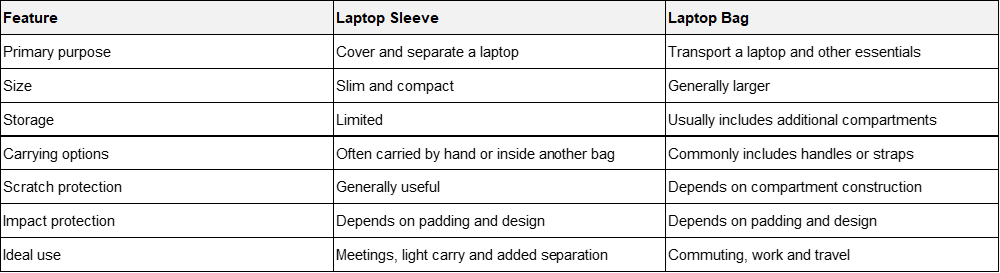
A laptop sleeve is often the better option when simplicity and portability are priorities.
A laptop bag becomes more practical when you regularly carry chargers, documents, headphones, notebooks and other essentials.
For many people, the most useful solution is not choosing one over the other, but using both when the situation requires it.
How to Choose the Right Laptop Sleeve Size
One of the most important considerations when purchasing a laptop sleeve is fit.
An incorrectly sized sleeve may allow excessive movement or place unwanted pressure on the device.
Don't Rely on Screen Size Alone
Laptop sizes are commonly advertised in inches, such as 13-inch, 14-inch, 15-inch or 16-inch.
However, these measurements usually refer to the diagonal display size, not the external dimensions of the entire laptop.
Two laptops advertised as 14-inch models may have noticeably different body dimensions because of their bezels, thickness and overall construction.
This means a sleeve marketed for a 14-inch laptop will not necessarily fit every 14-inch device.
Measure Your Laptop Correctly
Before purchasing, check three measurements:
Width: The external measurement from one side of the laptop to the other.
Depth: The external measurement from the front edge to the back.
Thickness: The height of the laptop when closed.
Compare these measurements with the sleeve's usable internal dimensions rather than relying exclusively on its advertised size.
Remember that external sleeve dimensions may include seams, folds and other construction details that reduce the available interior space.
Should a Laptop Sleeve Be Tight or Loose?
A laptop sleeve should fit snugly enough to limit unnecessary movement while allowing the device to be inserted and removed comfortably.
An excessively tight fit may put pressure on the laptop or make the sleeve difficult to use.
An oversized sleeve may allow the laptop to shift during transportation.
The ideal fit is secure without requiring force.
When in doubt, confirm the product's internal dimensions and compatibility guidance before purchasing.
Are Leather Laptop Sleeves Worth It?
A leather laptop sleeve can be a worthwhile choice for someone who values natural materials, understated design and a professional appearance.
Unlike many conventional fabric sleeves, leather offers a distinctive surface texture and visual character.
Depending on the leather type, finish and use, it may also develop subtle changes in colour and appearance over time.
However, leather should not automatically be considered more protective than other sleeve materials.
A padded textile sleeve may provide better cushioning against impacts than a thin, unpadded leather design.
The advantages of a leather sleeve are often found in the balance between practicality, material character and aesthetics.
What to Look for in a Quality Leather Laptop Sleeve
When comparing leather laptop sleeves, pay attention to:
Leather selection: Consider the type, finish and suitability of the leather.
Interior construction: Look for materials and seams that will not scratch the device.
Fit: Confirm compatibility with your laptop's external measurements.
Edge finishing: Check whether edges are neatly finished and comfortable to handle.
Closure design: Ensure the laptop remains appropriately secured.
Protective construction: Assess padding and reinforcement separately from appearance.
Everyday practicality: Consider whether the sleeve fits inside your existing work bag.
Premium materials are valuable, but the complete construction determines how well a sleeve performs in everyday use.
Introducing the Valmont Leather Laptop Sleeve by NORETI
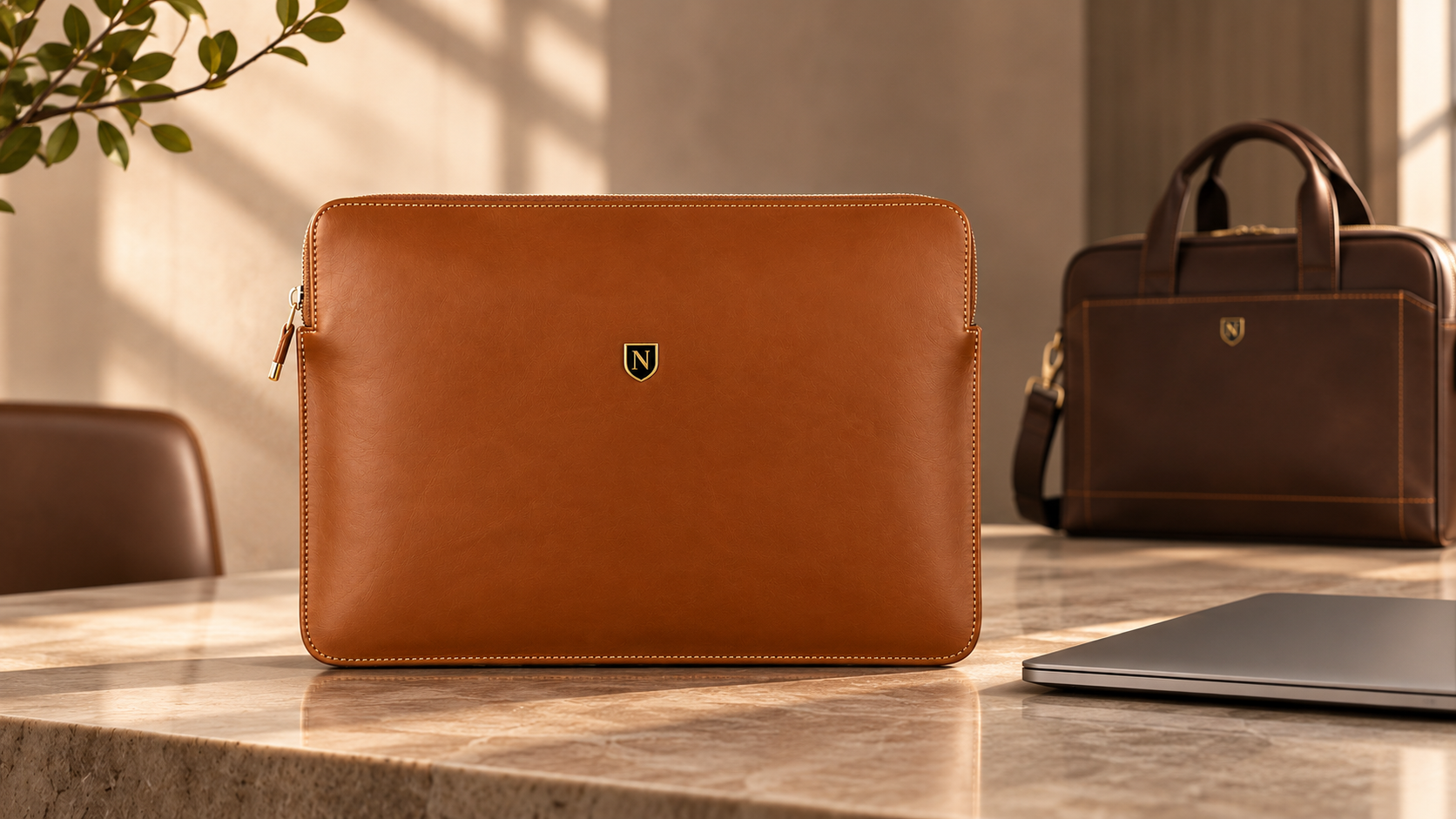
For those seeking a refined approach to carrying their technology, the NORETI Valmont Leather Laptop Sleeve combines a minimalist silhouette with the natural character of genuine leather.
Crafted from selected top-layer genuine leather, Valmont features an envelope-inspired design, clean lines and understated NORETI shield detailing.
Its slim profile is intended to complement professional and everyday settings without the bulk of a conventional laptop bag.
Designed for many laptops and tablets up to approximately 14 inches, Valmont measures approximately 35.5 × 25.6 × 2 cm.
Its close-fitting construction makes it suitable for carrying independently between meetings or placing inside a compatible briefcase, backpack or travel bag.
Available in three timeless finishes:
Black: Minimalist, contemporary and effortlessly professional.
Dark Coffee: Deep, understated and well suited to classic business accessories.
Cognac Brown: Warm and distinctive, with a naturally expressive appearance.
Beyond laptop storage, its streamlined format also lends itself to carrying slim documents and notebooks.
As with any laptop sleeve, compatibility depends on the device's actual dimensions. The Valmont should be selected for its intended everyday use rather than treated as a drop-proof or waterproof protective case.
Explore the NORETI Leather Laptop Sleeve Collection to discover the Valmont range.
Can a Laptop Sleeve Protect Against Water Damage?
A laptop sleeve may offer limited separation from light moisture, but most standard sleeves should not be considered waterproof.
Protection depends on the material, seams, openings, closure and any water-resistant treatment.
A leather laptop sleeve, in particular, should not be exposed unnecessarily to heavy rain or prolonged moisture.
If you regularly commute in wet conditions, consider using a bag with verified weather-resistant construction and a secure closure.
Keep liquids in a separate compartment and avoid placing a laptop directly beside an unsealed drink bottle.
If a leather sleeve becomes wet, follow the manufacturer's care instructions and allow it to dry naturally away from direct heat.
A laptop sleeve should never be relied upon as the sole defence against liquid damage.
How to Care for a Leather Laptop Sleeve
Proper care can help preserve the appearance and condition of a leather laptop sleeve.
Start with a few straightforward habits.
Keep the surface clean. Remove loose dust using a soft, dry cloth. Avoid abrasive cleaning materials.
Limit moisture exposure. Do not soak the leather or expose it unnecessarily to rain.
Avoid excessive heat. Keep the sleeve away from radiators, heaters and prolonged direct sunlight.
Use appropriate leather-care products. Different finishes require different treatments. Test any recommended product on an inconspicuous area before applying it more broadly.
Avoid overloading. Do not force bulky chargers or accessories into a sleeve designed primarily for a laptop.
Store thoughtfully. When not in use, keep the sleeve in a clean, dry environment without heavy objects placed on top.
Regular, appropriate care is generally more beneficial than aggressive cleaning or excessive conditioning.
Frequently Asked Questions About Laptop Sleeves
Is a laptop sleeve necessary?
A laptop sleeve is not essential for everyone. It is particularly useful when carrying a laptop inside an unpadded bag, transporting it frequently or seeking additional protection against scratches and everyday contact.
If your existing laptop compartment already provides sufficient protection, a sleeve may be optional.
Do laptop sleeves actually protect laptops?
Yes, laptop sleeves can help reduce scratches, scuffs and contact with surrounding objects.
Padded sleeves may also provide some cushioning against minor bumps.
However, protection varies by design, and no ordinary laptop sleeve should be assumed to prevent damage from a significant drop.
Should I use a laptop sleeve inside a backpack?
Using a laptop sleeve inside a backpack can be beneficial when the bag lacks a dedicated padded compartment or when the laptop shares space with other items.
If the backpack already provides adequate padding and separation, the additional benefit may be smaller.
Is it safe to carry a laptop without a sleeve?
Yes, provided the laptop is transported carefully in a suitable protective compartment or case.
A sleeve is an optional accessory rather than a requirement for safe laptop ownership.
Can a 14-inch laptop fit in a 13-inch sleeve?
Not necessarily.
Screen-size labels do not provide enough information to establish compatibility.
Always compare the laptop's external width, depth and thickness with the sleeve's usable interior dimensions.
Is a leather laptop sleeve better than neoprene?
Neither material is universally better.
Leather may appeal to buyers seeking natural texture, a professional appearance and timeless styling.
Neoprene sleeves can offer flexible cushioning and lightweight practicality.
The better choice depends on the sleeve's construction and your personal priorities.
Can I carry a laptop in a sleeve without a bag?
Yes. A suitably designed sleeve can be convenient for short movements between rooms, offices and meetings.
For longer commutes, heavy accessories or demanding travel conditions, a protective laptop bag may be more practical.
Do laptop sleeves help prevent overheating?
A laptop sleeve is intended for transportation and storage, not temperature control.
Avoid using a laptop while it remains inside a sleeve unless the device and sleeve manufacturers explicitly permit it. Covering ventilation areas may interfere with cooling.
Final Verdict: Is a Laptop Sleeve Worth Buying?
For many laptop owners, a sleeve is a simple accessory that can make everyday transportation more considered and convenient.
It helps keep a device separated from surrounding belongings, reduces direct contact with potentially abrasive surfaces and provides a streamlined option for moving between workspaces.
Its value becomes particularly clear for people who commute regularly, carry their laptop in different bags or prefer a minimalist approach to everyday essentials.
Yet a laptop sleeve is not necessary in every situation.
The right choice depends on the protection already provided by your bag, the way you transport your device and the level of impact resistance you require.
A well-chosen sleeve should fit correctly, suit your routine and complement the way you work.
For those who appreciate the natural character of leather and the elegance of understated design, a carefully crafted leather laptop sleeve offers something beyond simple practicality.
It transforms an everyday object into a considered part of your professional essentials.
Because true distinction is often found in the details.
NORETI™ — The Art of Distinction.
Further Reading & References
HP — How to Choose a Laptop Bag: Sleeves, Backpacks and Sizing — Guidance on the different protective functions of laptop sleeves, cases and bags.
NORETI — Backpack vs Briefcase: Which Is Better for Work? — Comparing professional bag styles, laptop compartments, commuting and everyday organisation.
The NORETI Journal — Further guides to leather quality, work accessories, travel and considered design.

Full-Grain Leather Backpack vs Canvas Backpack: Which Is Better?
Choosing between a full-grain leather backpack and a canvas backpack is not about finding a universal winner. Each material offers distinct advantages in durability, weight, style, maintenance, weather resistance, and long-term value. In this guide, we compare leather and canvas backpacks side by side to help you determine which option best suits your lifestyle, travel needs, and personal preferences.
Choosing between a full-grain leather backpack and a canvas backpack is not simply a question of which material is better. Both can make excellent backpacks, but they serve different priorities.
Full-grain leather may appeal if you value natural character, structure, a polished appearance, and the possibility of a distinctive patina. Canvas may be more suitable if you prefer a relaxed look, greater flexibility, potentially lower weight, or a simpler everyday carry.
However, material is only part of the decision. Stitching, strap reinforcement, zippers, hardware, lining, padding, panel thickness, and overall design can have as much influence on a backpack’s performance as the outer material itself.
This balanced leather backpack vs canvas backpack comparison examines durability, weight, maintenance, weather behavior, appearance, travel, professional use, and long-term value so you can choose according to how you actually carry.
Full-Grain Leather and Canvas: Understanding the Materials
What is full-grain leather?
Full-grain leather retains the hide’s original grain surface after the hair and epidermis have been removed. The grain has not been removed through buffing, snuffing, or surface correction.
Importantly, “full-grain” describes the condition of the leather’s surface. It does not, by itself, guarantee a particular thickness, finish, level of water resistance, or service life. Those characteristics also depend on the animal hide, tannage, finish, manufacturing specifications, and construction of the finished backpack.
This distinction matters when comparing products. Two backpacks labeled “full-grain leather” may have very different weights, finishes, lining materials, hardware, and levels of protection.
What is canvas?
Canvas is a woven fabric commonly made from cotton, although canvas can also incorporate polyester or other fibers. Many cotton canvas fabrics use a plain weave, in which warp and weft yarns cross in an alternating pattern.
Plain-weave fabrics have frequent yarn intersections, which can create a stable fabric with relatively low susceptibility to skew, snagging, seam slippage, or picking. However, canvas performance still varies with yarn quality, fabric weight, weave density, fiber composition, and surface treatment.
Common backpack variations include:
Untreated cotton canvas
Heavyweight canvas
Cotton duck or duck canvas
Waxed canvas
Cotton and synthetic blends
Coated or proofed canvas
Therefore, the word “canvas” should not be treated as one fixed performance specification. A lightweight untreated canvas backpack and a heavyweight waxed canvas backpack can behave very differently.
Leather Backpack vs Canvas Backpack: Quick Comparison
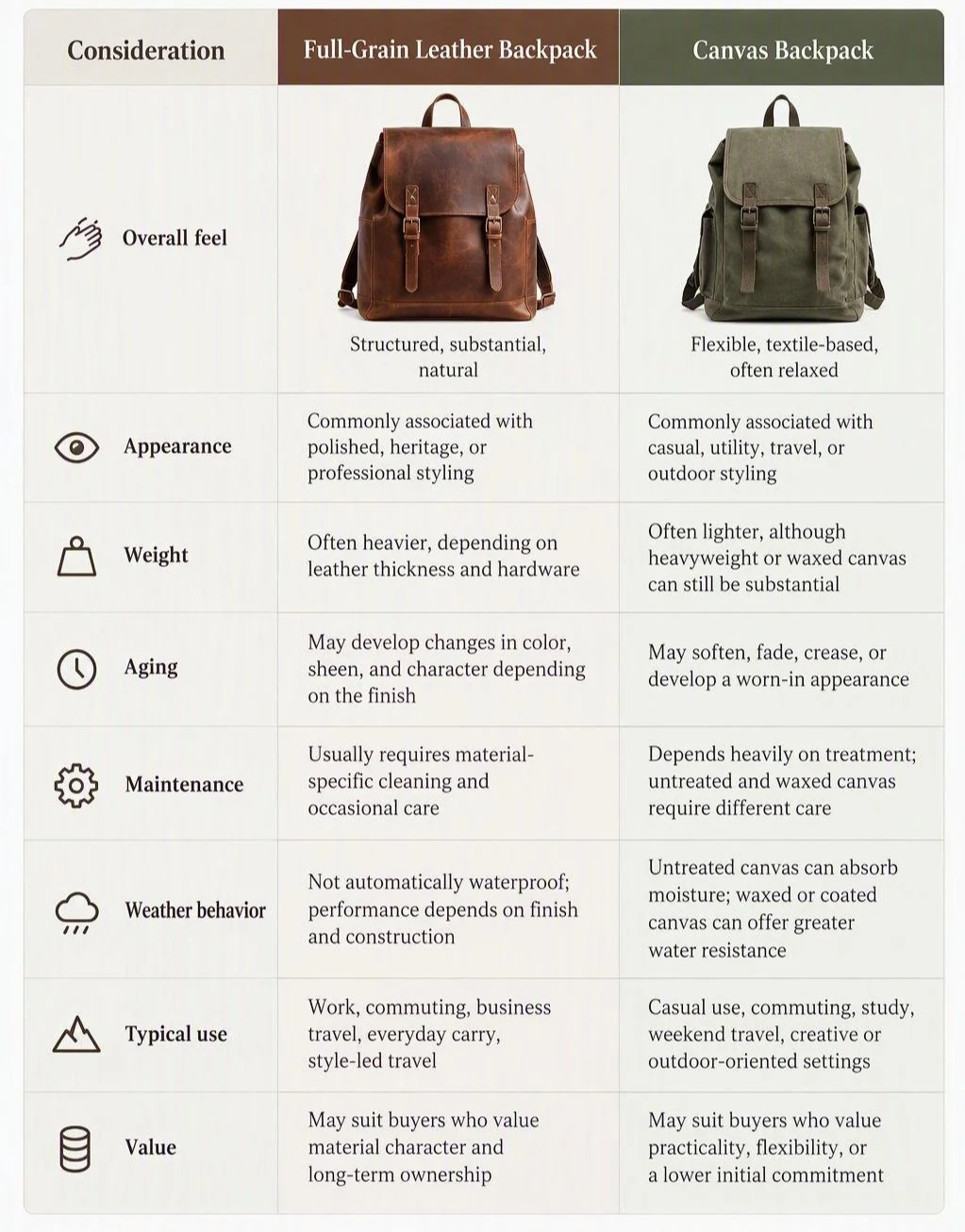
These are general tendencies, not universal rules. A lightly constructed leather backpack may weigh less than a heavily reinforced waxed canvas model, while a premium canvas backpack may cost more than an entry-level leather one.
Which Material Is More Durable?
Both full-grain leather and quality canvas can be durable, but they respond to use in different ways.
Full-grain leather retains its original grain surface, but the label alone does not prove how a finished backpack will perform. Leather thickness, tanning, finish, stitching, edge construction, lining, and reinforcement must all be considered.
Canvas durability is similarly variable. A tighter weave, heavier fabric, suitable coating, and reinforced construction can improve performance, while lighter canvas may prioritize flexibility and reduced weight.
Construction can matter more than the material name
When evaluating backpack durability, inspect:
Shoulder-strap attachment points
Reinforcement at handles and corners
Stitch consistency
Zipper quality and alignment
Bottom-panel protection
Lining and internal seams
Edge finishing
Hardware attachment
Repairability
Manufacturer care and warranty information
Even premium backpack materials cannot compensate for weak strap anchors, poorly installed zippers, or unreinforced seams. Reinforced stitching at stress points and reliable hardware contribute directly to the durability of a finished backpack.
A well-designed canvas backpack can therefore outperform a poorly constructed leather backpack—and the reverse is equally possible.
Weight and Carrying Comfort
Leather backpacks are often heavier because leather panels, substantial hardware, structured bases, and reinforced components can add weight. However, canvas should not automatically be described as lightweight. Heavyweight duck canvas, wax treatments, thick linings, leather trim, padding, and metal hardware can also produce a substantial bag.
For an accurate comparison, check the published empty weight of the exact backpack, rather than relying on material alone.
Comfort also depends on:
Shoulder-strap width
Strap shape and padding
Back-panel structure
Backpack dimensions
Load distribution
Placement of heavier items
Fit relative to the wearer
The weight carried each day
If you regularly walk long distances or need to meet airline carry-on weight limits, empty weight may be a major consideration. If you mainly commute by car or carry a modest daily load, structure, appearance, and organization may matter more.
How Leather and Canvas Age
The character of full-grain leather
Some full-grain leathers develop a patina as they are handled and exposed to everyday use. Patina may appear as changes in color, sheen, softness, and surface character.
The degree of change depends heavily on the leather’s finish. Aniline leather, for example, has little or no pigment finish, absorbs moisture more readily, and can develop a particularly visible patina. More protective pigmented finishes may age differently and offer greater resistance to liquids and staining.
Natural markings, color variation, and gradual changes are often part of the appeal of a full-grain leather backpack. Buyers who want a completely uniform appearance should examine the leather finish and product photographs carefully.
How canvas changes over time
Canvas generally develops a softer, more relaxed appearance with use. Depending on its color and finish, it may show fading, creases, rubbing, or wear at corners and high-contact areas.
Waxed canvas has its own form of character. The waxed surface can mark or crease where it is folded or handled, and scuffed areas may appear lighter. British Millerain describes these marks as normal characteristics of the waxed finish rather than manufacturing faults.
Waxed canvas can also be reproofed when its wax layer wears down, helping restore its weather-resistant properties and appearance.
Neither aging style is objectively better. Leather typically offers a more organic, polished evolution, while canvas often develops a softer, utilitarian, or adventure-worn character.
Weather and Water Resistance
Neither a full-grain leather backpack nor a canvas backpack should automatically be assumed to be waterproof.
Full-grain leather in wet weather
“Full-grain” is not a waterproof specification. Water behavior depends on tannage, surface finish, conditioning, seams, lining, closures, and the construction of the complete bag.
Some finished leathers can tolerate brief exposure to light moisture, while open-pore or lightly finished leather may absorb water more readily. Direct or prolonged exposure can cause staining, stiffening, color changes, or deformation in some leathers.
If a leather backpack becomes wet, allow it to dry naturally away from direct heat or intense sunlight. Forced heat can damage the material.
Canvas in wet weather
Untreated cotton canvas can absorb moisture. Waxed, coated, or proofed canvas can provide greater resistance, but water-resistant does not necessarily mean waterproof.
British Millerain, a specialist in waxed cotton, describes its fabrics as water resistant and recommends regular reproofing to maintain weather protection. The performance of a completed backpack also depends on seams, zipper construction, closures, lining, and openings—not only the outer fabric.
If protection from sustained rain is essential, look for a product-specific water-resistance claim or test information. Also examine protected zippers, storm flaps, coated linings, seam construction, and closure design.
Maintenance and Cleaning
Leather backpack care
Leather care should be based on the particular finish, not simply the term “full-grain.”
General principles include:
Follow the maker’s care instructions.
Remove loose dirt gently.
Use products formulated for the particular leather.
Patch-test any cleaner or conditioner in a hidden area.
Avoid harsh rubbing and household solvents.
Allow wet leather to dry naturally.
Do not apply conditioner automatically on a fixed schedule; assess the leather’s finish and condition first.
Leather Naturally notes that different leather finishes require different treatment. It also recommends patch testing, appropriate products, and natural drying away from direct heat.
Canvas backpack maintenance
Care requirements differ significantly between untreated, coated, blended, and waxed canvas.
Some untreated canvas products may permit hand or machine washing, while traditional waxed canvas often should not be machine washed, dry-cleaned, tumble-dried, ironed, or cleaned with detergent. These processes can remove or damage the wax finish.
For waxed canvas, the manufacturer may recommend brushing off dry dirt, carefully sponging localized areas with cold water, and reproofing when water no longer beads effectively.
Always follow the backpack’s own care label. “Canvas” alone does not tell you whether a product is washable.
Appearance: Professional or Casual?
A full-grain leather backpack often suits wardrobes and environments where a more structured or polished appearance is preferred. It can complement business-casual clothing, tailored outerwear, client meetings, and business travel.
Canvas generally has a more relaxed visual language. It works naturally with casual clothing, denim, weekend travel, creative workplaces, and outdoor-inspired wardrobes.
These are conventions rather than restrictions. A clean, minimal canvas backpack can look appropriate in many professional environments, while a softly structured leather backpack can work equally well with casual clothing.
Consider:
Your workplace dress expectations
The colors you wear most often
Whether you prefer a structured or relaxed silhouette
How visible wear and marks will make you feel
Whether you want the backpack to blend in or become a feature
Which Is Better for Work?
A full-grain leather backpack for work may suit you if:
You prefer a polished or structured appearance.
Your wardrobe leans toward business or smart casual.
You value natural material variation and patina.
You are comfortable with material-specific care.
A modest increase in empty weight is acceptable.
A canvas work backpack may suit you if:
Your workplace is casual or creative.
You walk or use public transportation frequently.
Flexibility and everyday practicality are priorities.
You prefer a less formal appearance.
You want a broader range of colors or textile finishes.
For either material, laptop protection, strap comfort, internal organization, and zipper security are likely to matter more during daily use than appearance alone.
Which Is Better for Travel?
A full-grain leather backpack may work particularly well for business trips, city travel, and journeys where presentation matters. Its structure can help maintain a clean silhouette, although empty weight and exposure to rain should be considered.
A canvas backpack for travel may suit weekend trips, road travel, and casual itineraries where flexibility and a relaxed appearance are preferred. Waxed canvas may provide additional weather resistance, but its care requirements should still be checked.
For frequent travel, compare:
Empty backpack weight
External dimensions
Carry-on suitability
Laptop protection
Luggage pass-through
Strap comfort
Security of closures
Weather protection
Ease of cleaning
Access while moving
The best backpack material for travel is the one that supports your particular journey—not the one that wins an abstract material comparison.
Is a Leather Backpack Worth It?
A leather backpack may be worth it when you value the feel of natural leather, a more refined appearance, structural character, and the way a particular leather changes with use.
It may be less suitable if your main priorities are minimum weight, minimal maintenance, frequent exposure to heavy rain, or a lower initial purchase price.
Similarly, canvas may represent better value if you prefer casual versatility, fabric flexibility, and a simpler ownership experience. Premium waxed or heavyweight canvas, however, may still require specialized care and can carry a premium price.
Instead of asking only, “Is a leather backpack worth it?”, consider:
Will I enjoy carrying it regularly?
Is its empty weight practical for me?
Does its organization suit my routine?
Am I willing to follow its care instructions?
Is the construction appropriate for my load?
Can worn parts be repaired?
Does the appearance fit most of my wardrobe?
Is the material appropriate for my local weather and travel habits?
Value is personal. A backpack used regularly and cared for properly may provide greater value than a cheaper option that does not suit your routine.
Frequently Asked Questions
What is the best backpack material?
There is no universal best backpack material. Full-grain leather may be preferable for natural character, structure, and polished styling. Canvas may be preferable for casual versatility, textile flexibility, and potentially lower weight. Construction quality and intended use should guide the final choice.
Are canvas backpacks waterproof?
Not necessarily. Untreated canvas can absorb moisture. Waxed, coated, or proofed canvas can be water resistant, but full waterproofing depends on the fabric treatment and complete bag construction, including seams, zippers, and closures.
Is full-grain leather waterproof?
No. Full-grain describes the retained grain surface; it does not establish waterproof performance. The finish and completed backpack must be evaluated for any water-resistance claim.
Which material lasts longer?
There is no reliable universal answer. Material thickness, finish, stitching, reinforcement, hardware, use, care, and repairability all influence lifespan. A well-constructed backpack in either material can be a strong long-term choice.
Which is lighter: leather or canvas?
Canvas backpacks are often lighter than comparable full-leather designs, but this is not guaranteed. Heavy canvas, wax, padding, lining, leather trim, and hardware can narrow the difference. Compare the exact empty weights of the products you are considering.
Final Verdict: Choose According to Use, Not a Universal Winner
In the full-grain leather backpack vs canvas backpack comparison, neither material is universally better.
Choose full-grain leather if you are drawn to natural character, structure, a polished appearance, and the possibility of a distinctive patina—and you are comfortable with its weight and care requirements.
Choose canvas if you prefer a relaxed aesthetic, greater flexibility, potentially lower weight, or a backpack suited to casual everyday use. If weather resistance matters, consider waxed or proofed canvas and confirm the performance of the completed bag.
Most importantly, look beyond the material label. Strong stitching, reinforced straps, dependable zippers, thoughtful organization, comfortable carrying, and appropriate weather protection determine whether a backpack will genuinely work for your life.
The right choice is not the material that wins every category. It is the backpack whose materials, construction, appearance, and care requirements best match how you intend to carry it.
NORETI — The Art of Distinction.
Explore the NORETI collection of premium leather bags, business accessories and contemporary travel essentials.
Resources & Historical Accuracy
To ensure this article is balanced, accurate, and based on recognized material standards rather than marketing claims, the following references were consulted:
Leather Definitions and Technical Standards
Leather Research Laboratory (Leather USA) – Definitions of full-grain and top-grain leather, including the internationally recognized definition of full-grain leather as leather retaining the original grain surface.
Source: Leather Research Laboratory, Leather Industries of America.International Organization for Standardization (ISO) and International Union of Leather Technologists and Chemists Societies (IULTCS) definitions referenced through Leather Research Laboratory.
Leather Care and Performance
Leather Naturally – Guidance on leather types, ageing, patina development, water exposure, cleaning, conditioning, and long-term care. Source: Leather Naturally Industry Fact Sheets.
Canadian Conservation Institute (Government of Canada) – Research on leather properties, water resistance, deterioration, humidity effects, and long-term preservation of leather products. Source: Canadian Conservation Institute, Caring for Leather, Skin and Fur.
Canvas and Textile Construction
CottonWorks™ – Technical information regarding woven cotton fabrics, plain-weave canvas construction, stability, and durability characteristics. Source: Cotton Incorporated, CottonWorks Learning Hub.
British Millerain – Historical and technical information on waxed cotton, including weather resistance, maintenance, reproofing, and the historical development of waxed canvas. Source: British Millerain, one of the world's oldest waxed cotton manufacturers.
Backpack Construction and Durability
Industry references on backpack construction, including:
Reinforced stitching
Strap attachment points
Hardware quality
Zipper performance
Material selection
These sources were used to support the principle that overall backpack longevity depends on construction quality as much as material choice.
Historical Context
Canvas backpacks trace their origins to heavy woven fabrics traditionally used for sails, tents, military packs, and work equipment. The word canvas is believed to derive from the Latin cannabis, referencing the hemp fibers originally used in its production.
Leather backpacks have origins in early travel, military, and trade equipment dating back thousands of years. Vegetable-tanned leather bags and packs were used throughout ancient civilizations, including the Roman Empire and later across Europe for travel, hunting, and commerce.
Waxed canvas emerged from maritime applications. Sailors treated canvas sails with oils to improve weather resistance. During the late 19th and early 20th centuries, manufacturers such as British Millerain refined the process into modern waxed cotton textiles used in outdoor clothing, luggage, and bags.
Accuracy Statement
This article intentionally avoids declaring either material as the universally superior choice.
Material performance depends on multiple factors, including:
Material quality
Fabric weight
Leather finish
Stitching methods
Hardware quality
Backpack design
Maintenance practices
Intended use
For this reason, comparisons are presented as general characteristics rather than absolute rules. Individual products may perform differently depending on their construction and specifications.
Last reviewed: October 2026
Author: NORETI
Review standard: Material characteristics, construction quality, practical ownership experience, and publicly available industry references.

The History of Leather: A 5,500-Year Journey of Craftsmanship
Journey through 5,500 years of leather history, from an extraordinary discovery in ancient Armenia to the origins of tanning and modern luxury craftsmanship. Discover how leather became one of the world's most enduring materials.
From an ancient cave in Armenia to the refined leather goods of today, discover the remarkable history of one of humanity's most enduring materials.
Some materials are defined by fashion. Others are defined by time.
Leather belongs to the latter.
Long before the existence of luxury fashion houses, modern cities or the concept of designer accessories, our ancestors had already discovered the remarkable potential of animal hides.
What began as a practical means of protection would eventually become one of the most recognisable materials in the history of craftsmanship.
Its story is one of human ingenuity, ancient civilisations and a pursuit of refinement that has endured for thousands of years.
And one of its most extraordinary chapters begins in a quiet cave in Armenia.
A Discovery Hidden for 5,500 Years
In 2008, archaeologists exploring the Areni-1 cave complex in Armenia uncovered something extraordinary.
Hidden beneath layers of history was a remarkably preserved leather shoe, dating to approximately 3500 BC.
It was not an elaborate object of wealth or status.
It was a simple piece of footwear, fashioned from a single piece of leather and shaped to protect the human foot.
Yet its significance was profound.
The discovery provided direct evidence of sophisticated leatherworking more than five millennia ago.
Its carefully constructed form revealed something remarkably familiar: even in prehistoric times, people understood the importance of selecting, shaping and working materials to meet everyday needs.
Thousands of years before modern leather workshops, the fundamental relationship between material, function and craftsmanship was already taking shape.
The story of leather was never simply about what people carried or wore. It was about what they could create.
Where Did Leather Originally Come From?
The origins of leather stretch much further back than the Armenian discovery.
Early humans used animal skins for warmth, shelter and protection. Over time, they developed methods of cleaning, softening and preserving hides, transforming a perishable natural material into something more useful.
These early techniques gradually evolved into leatherworking and tanning traditions.
Unlike untreated hides, properly processed leather could offer greater flexibility, durability and resistance to deterioration.
This transformation represented an important technological achievement.
A natural material that might otherwise decay could become clothing, footwear, containers and equipment designed for repeated use.
There is no single known inventor of leather.
Its development was the result of generations of experimentation across different cultures and regions.
What emerged was not merely a material, but an enduring craft.
Ancient Egypt: When Leather Became an Art
As civilisations developed, so did their understanding of leather.
In ancient Egypt, leather was used for sandals, belts, bags, furniture, shields and ceremonial objects.
Archaeological discoveries reveal that Egyptian craftspeople also explored colour, surface decoration and techniques for preparing animal hides.
Leather was no longer valued solely for its practicality.
It became a medium through which skill, appearance and purpose could meet.
Imagine the workshops of ancient Egypt: craftspeople preparing hides, working surfaces, shaping pieces and creating objects intended for daily life.
Every finished piece required an understanding of the material.
Its thickness. Its flexibility. Its strength. Its intended purpose.
These considerations remain central to quality leather goods today.
Although the tools and production techniques have changed considerably, the importance of understanding the material has not.
The Art of Tanning: Transforming Hide Into Leather
At the heart of leather's history lies one of its most important developments: tanning.
Tanning is the process of treating animal hides to improve their stability and resistance to decomposition.
Across history, craftspeople developed different methods using natural fats, oils, plant materials and mineral substances.
One particularly important tradition is vegetable tanning.
This process uses tannins found in botanical sources, such as tree bark and other plant materials, to transform hides into leather.
Vegetable-tanned leather remains appreciated for its distinctive characteristics and its potential to develop a rich patina through use.
Modern leather production also includes other tanning methods, each producing different properties and finishes.
Understanding these distinctions helps explain why genuine leather products can vary so significantly in texture, appearance, flexibility and performance.
The character of leather is shaped not only by nature, but by the way the material is prepared.
From Ancient Utility to Luxury Leather Goods
Over the centuries, leather became increasingly important in commerce, transportation, clothing and personal accessories.
Travellers relied on leather bags and pouches to carry their belongings.
Artisans produced belts, footwear and protective equipment.
As leatherworking traditions developed, decorative techniques and increasingly refined construction methods expanded what could be achieved with the material.
Eventually, leather became closely associated with fine luggage, sophisticated handbags, leather briefcases and luxury accessories.
Its appeal extended beyond practical durability.
People came to appreciate the richness of its texture, the precision of its construction and the individuality of its appearance.
The finest leather goods demonstrated how a functional object could also become an expression of personal taste.
This relationship between utility and elegance remains fundamental to contemporary leather design.
Why Leather Still Matters in Modern Luxury
In a world defined by rapidly changing trends, leather continues to hold a distinctive place in fashion and design.
Part of its appeal lies in its versatility.
A structured leather briefcase can communicate quiet professionalism.
A carefully designed leather wallet can bring refinement to an everyday essential.
A leather travel bag can combine practical organisation with an understated sense of style.
Different types of leather also offer their own characteristics.
Full-grain leather retains the natural grain surface of the hide, while top-grain leather may undergo additional finishing to achieve a particular appearance.
Depending on the material and its treatment, leather can develop subtle changes in colour, texture and character over time.
These qualities help explain why leather has remained relevant across generations.
But the value of a leather accessory cannot be judged by its material alone.
Thoughtful proportions, secure stitching, appropriate hardware and careful finishing are equally important.
True craftsmanship is found in how these elements work together.
A New Chapter: Leather and Contemporary Design
The modern world offers a wider range of materials and manufacturing techniques than ever before.
Alongside traditional genuine leather, premium vegan leather alternatives have become part of contemporary accessory design.
Each material presents different possibilities in appearance, texture, care and construction.
For the modern customer, the most important consideration is not simply tradition, but making an informed choice.
At NORETI, we appreciate both the heritage of genuine leather and the possibilities offered by thoughtfully selected modern materials.
Our approach to premium leather goods and accessories is guided by considered design, functionality and understated sophistication.
We believe that an accessory should complement the life of its owner rather than compete for attention.
It should feel purposeful.
It should be beautifully proportioned.
And its details should reward a closer look.
From an Ancient Cave to the Modern Wardrobe
Consider the journey.
More than 5,500 years ago, someone shaped a piece of leather into a shoe.
Today, leather is used to create refined briefcases, elegant handbags, wallets and accessories carried around the world.
The distance between these two moments is extraordinary.
Yet they share a simple idea: materials become meaningful through human creativity and skill.
The tools have evolved. The designs have changed. The possibilities have expanded.
But the appreciation for thoughtful craftsmanship remains.
Perhaps that is the most remarkable part of leather's story.
Not simply that the material has survived for thousands of years, but that people have continued to find new ways to give it purpose.
Frequently Asked Questions About the History of Leather
When was leather first invented?
There is no established date for the invention of leather. Humans used and processed animal hides in prehistoric times, long before written records. Archaeological discoveries provide evidence of ancient leatherworking traditions.
What is the oldest known leather shoe?
The Areni-1 leather shoe, discovered in Armenia in 2008 and dating to approximately 3500 BC, is among the oldest known examples of preserved leather footwear.
Which ancient civilisation first used leather?
Leather and animal-hide processing developed in prehistoric societies. Ancient Egypt and Mesopotamia provide important archaeological evidence of early leatherworking, but neither can definitively be identified as its sole origin.
How was leather made in ancient times?
Ancient craftspeople used methods including drying, cleaning, softening and treating hides with fats, oils, plant materials and other substances. Techniques varied across cultures and historical periods.
Why is leather associated with luxury?
Leather's natural characteristics, versatility and long association with skilled craftsmanship have contributed to its place in luxury fashion and accessories. Material selection, design and construction determine the quality of the finished product.
The Art of Distinction
The history of leather reminds us that meaningful design is rarely separated from the past.
Every material has a story.
Every craft has an origin.
And every thoughtfully created object becomes part of a continuing tradition.
At NORETI, we draw inspiration from this enduring appreciation for materials, purpose and refined craftsmanship.
Because true luxury is not simply about what we own.
It is about the thought behind what we choose.
NORETI — The Art of Distinction.
Explore the NORETI collection of premium leather bags, business accessories and contemporary travel essentials.
Historical sources and accuracy
The article is an original retelling, not a copied historical text. These sources support its central historical claims:
The peer-reviewed archaeological study documenting the Areni-1 leather shoe and its dating. PMC
University College London research documenting ancient Egyptian leather bags, footwear and decorated leather objects. University College London
Museum and conservation resources explaining historical hide preservation and tanning practices. Development Services
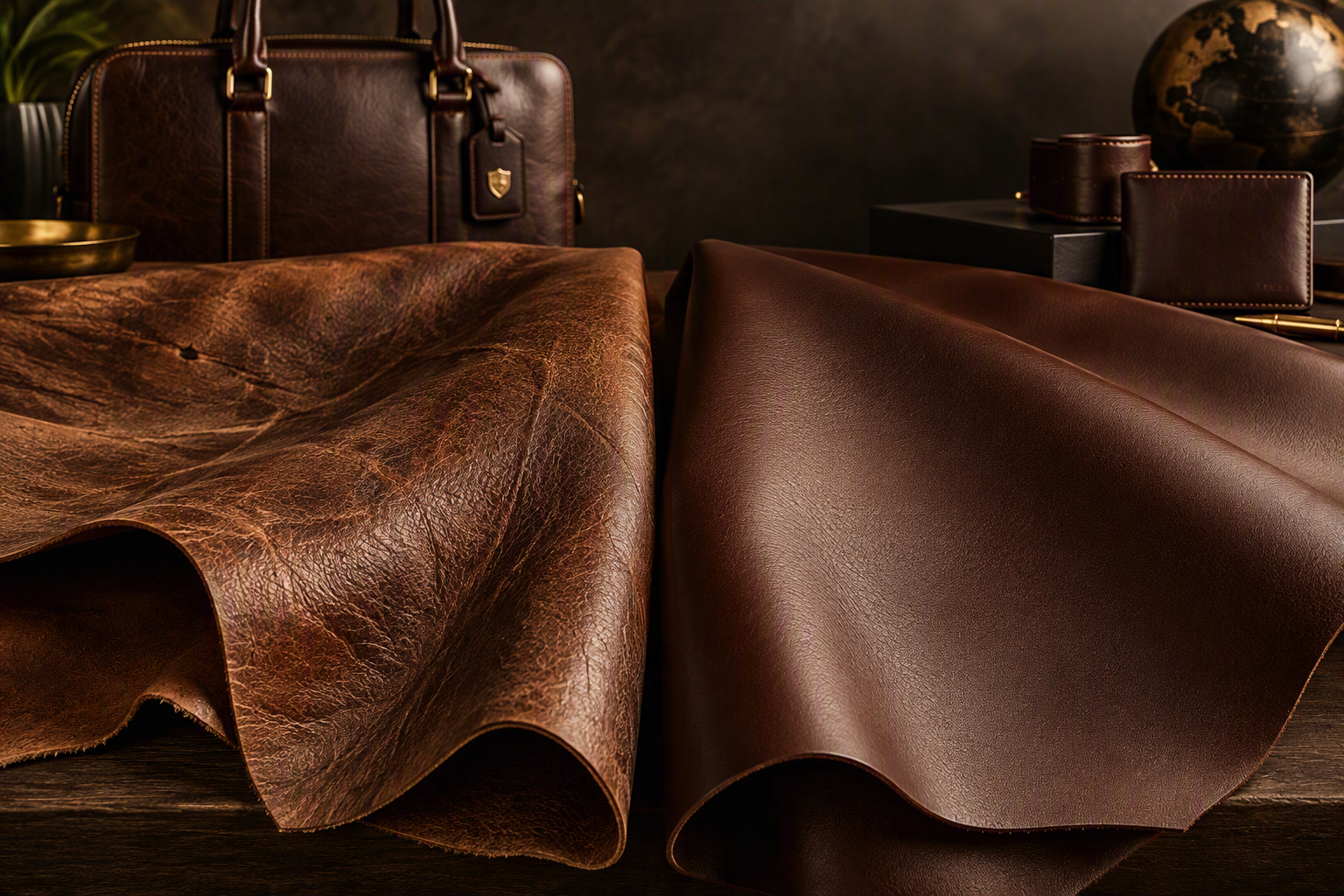
Full-Grain vs Top-Grain Leather: What’s the Difference?
Confused by the difference between full-grain and top-grain leather? You're not alone. While these terms are often used as indicators of quality, the reality is more nuanced. In this guide, we explore how full-grain and top-grain leather are made, how they differ in appearance, durability, ageing and maintenance, and why neither material is automatically superior in every situation. Whether you're choosing a leather briefcase, business bag, wallet or belt, understanding the facts behind the terminology will help you make a more informed decision and appreciate the craftsmanship behind premium leather goods.
Full-grain and top-grain leather are often presented as the two highest positions in a simple leather-quality hierarchy. The reality is more nuanced.
Full-grain leather retains its complete natural grain surface without corrective mechanical removal. “Top-grain”, however, is used inconsistently. In everyday retail language, it commonly describes leather from the grain-bearing upper layer whose surface has been lightly sanded, buffed or otherwise corrected for greater uniformity. In some technical and American industry usage, top grain may instead mean the grain-bearing upper layer generally—and can even be treated as equivalent to full grain. The Leather Research Laboratory at the University of Cincinnati, for example, states that full-grain and top-grain leather are the same under the terminology it follows.
For buyers, the most useful question is therefore not simply, “Is this top-grain leather?” It is:
Does the leather retain its complete natural grain, or has the grain surface been corrected and refinished?
That distinction tells you more about how the leather may look, feel and age.
What Does “Grain” Mean in Leather?
The grain is the outer side of the hide revealed after the hair or wool and epidermis have been removed. Its natural pattern includes follicles and surface characteristics specific to the animal. When a hide is split horizontally, the upper section carrying this surface is the grain split, while lower layers are referred to as flesh or middle splits.
This is important because terms such as full grain, corrected grain and split leather describe the structure or treatment of the material. They do not, by themselves, provide a complete measure of quality.
A leather’s final performance is also influenced by:
the condition and selection of the original hide;
tanning and retanning;
thickness and fibre consistency;
dyeing and fatliquoring;
surface finishing;
resistance to flexing, abrasion, colour transfer and moisture;
the product’s pattern, reinforcement and construction; and
stitching, lining, edge finishing, hardware and workmanship.
The diagram below shows why full grain, corrected grain and split leather should not be treated as interchangeable terms.
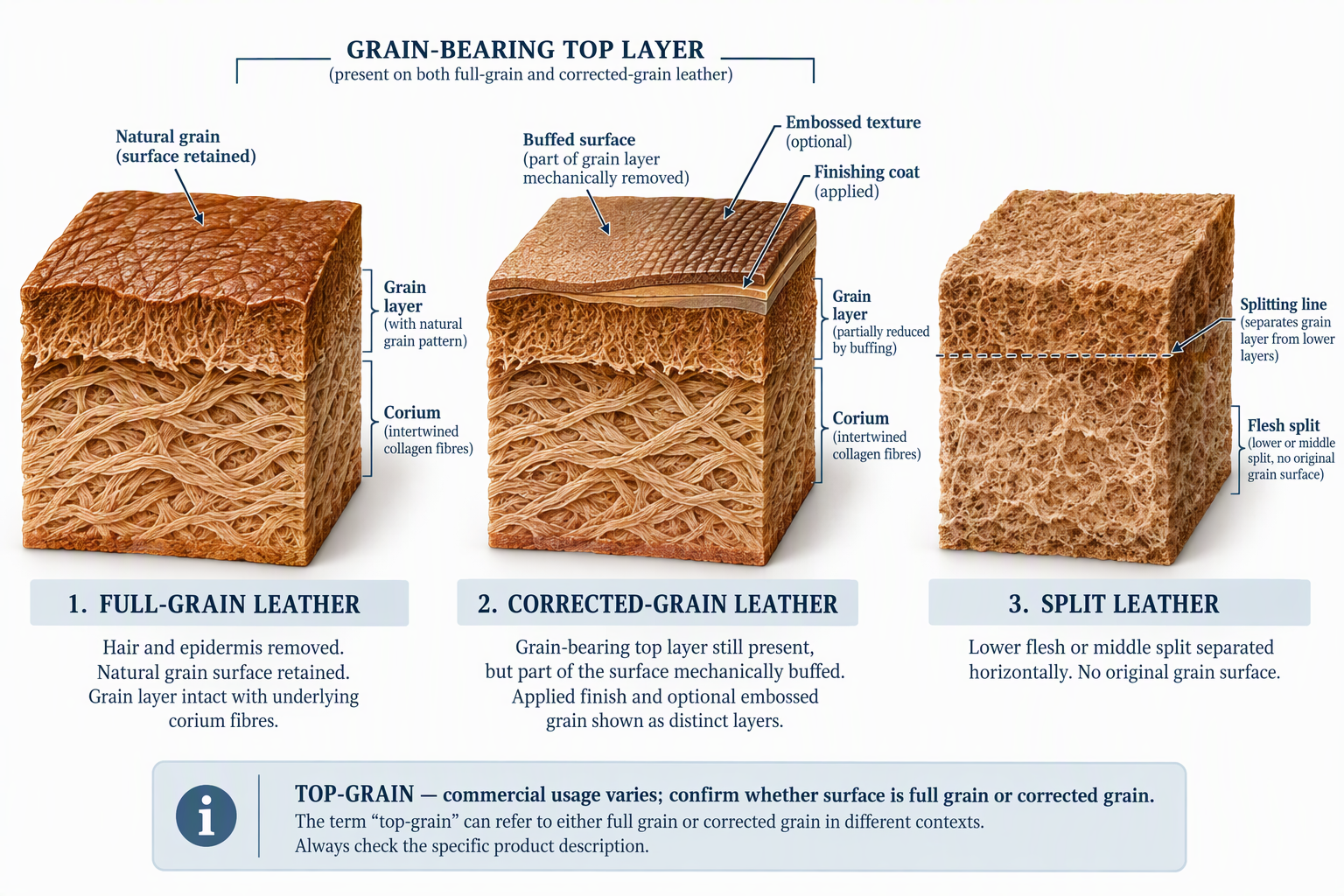
Figure 1: A simplified hide cross-section showing the technical distinction between full-grain leather, corrected grain from the grain-bearing layer, and split leather from a lower layer. “Top-grain” is shown as an ambiguous commercial term that should be clarified with the supplier.
What Is Full-Grain Leather?
Leather Working Group defines full grain as leather that has kept its entire grain, with none of the surface removed by corrective mechanical treatment.leatherworkinggroup
This does not mean full-grain leather must be completely unfinished. It may still be dyed, oiled, waxed, lightly coated, pigmented or even embossed. What defines it is that the original grain has not been removed through corrective sanding, snuffing or buffing.
Because the natural surface remains, full-grain leather may show:
variations in grain pattern;
pores and wrinkles;
tonal differences;
healed scratches or scars; and
other characteristics associated with a natural hide.
These markings should not automatically be interpreted as faults. Their significance depends on location, depth, concentration and the intended product. Commercial leather grading may separately assess how much usable cutting area a hide provides, so full grain is not the same thing as first grade or A grade.
Full-grain leather is particularly suitable when a designer wants natural variation, tactile character and a surface that can evolve visibly with use. However, its precise ageing behaviour still depends on the tannage and finish.
What Is Top-Grain Leather?
This is where terminology becomes less consistent.
In popular consumer usage, top-grain leather usually means leather from the grain-bearing upper portion of the hide that has undergone some degree of surface refinement. Small irregularities may be sanded or buffed, after which colour, protective coatings or an embossed texture may be applied.
That treatment can create:
a smoother and more predictable appearance;
greater consistency between panels;
more controlled colour and texture; and
surface properties tailored to the product’s intended use.
However, top grain is not a sufficiently precise technical specification on its own. Some suppliers use it broadly for any leather from the upper, grain-bearing layer. Others use it as shorthand for corrected-grain leather. As noted above, the Leather Research Laboratory uses top grain as equivalent to full grain.
For accurate product descriptions, it is better to indicate whether the leather is:
full grain with the natural grain intact;
lightly corrected grain;
corrected grain with a pigmented finish;
nubuck, where the grain side is buffed to create a nap; or
split leather with an applied or coated surface.
What Is Corrected-Grain Leather?
Leather Working Group defines corrected grain as leather in which the grain has been partially removed by buffing or a similar mechanical treatment and then enhanced through finishing.
During correction, the surface is passed against an abrasive material to reduce small grain irregularities and create a more uniform base. A finishing system can then add colour, protection, texture or an embossed grain pattern. Technical guidance recommended by IULTCS and UNIDO explains that finishing can include coatings, binders, pigments, protective films, smoothing and embossing, all of which can affect the leather’s final appearance and physical properties.
Corrected grain should not automatically be considered poor leather. A carefully selected, appropriately corrected and well-finished leather can be highly suitable for premium products requiring a clean, consistent appearance. The extent and quality of the correction matter considerably.
Full-Grain vs Top-Grain Leather: Comparison
Swipe horizontally to view the full comparison.
| Characteristic | Full-Grain Leather | Top-Grain Leather in Common Retail Usage |
|---|---|---|
| Grain surface | Complete natural grain retained | Grain-bearing upper layer retained, but the surface may be lightly or substantially corrected |
| Surface treatment | No corrective mechanical removal | Often sanded, buffed, refinished or embossed |
| Appearance | More natural variation and visible character | Usually smoother and more visually consistent |
| Finishing options | May be aniline, semi-aniline, pigmented, waxed, oiled or otherwise finished | Commonly finished for consistency, colour control or protection |
| Patina | Often more visible with natural, aniline, waxed or pull-up finishes | May develop subtler surface character; heavily pigmented finishes usually change less visibly |
| Liquid and stain behaviour | Depends primarily on openness and finish, not the full-grain name alone | A protective finish may improve repellency, but performance depends on the actual finishing system |
| Maintenance | Natural or open-pore versions may require more cautious care | Pigmented or protected versions can be easier to clean |
| Consistency | Natural markings and tonal variation may remain | Correction can provide more uniform panels |
| Best suited to | Products designed to celebrate natural character and individual ageing | Refined products requiring controlled colour, texture and a polished appearance |
| Quality conclusion | Can be excellent, but the term alone does not guarantee construction or performance | Can also be premium; quality depends on hide selection, degree of correction, finish and manufacturing |
Which Is More Durable?
It is tempting to say that full-grain leather is always stronger and top-grain leather is always weaker. That is too simplistic.
Full-grain leather retains the complete original grain surface, whereas correction removes part of that surface. All other factors being equal, preserving more of the original structure is generally desirable for demanding, long-term use. But real products are rarely equal in every other respect.
A poorly tanned, unsuitable or badly constructed full-grain product may perform worse than an appropriately specified corrected-grain product. Thickness, fibre structure, finish flexibility, stitch resistance, reinforcement, edge construction and hardware can all influence service life.
The better buying questions are:
Is the leather appropriate for the product?
What finish has been applied?
Is the leather thick and firm enough—or soft and flexible enough—for its function?
Are high-stress areas reinforced?
Are the stitching, lining, zips and hardware of comparable quality?
Which Develops the Best Patina?
A patina is the gradual surface character produced through handling, light, friction, oils and use. It may include changes in colour, sheen and tonal depth.
Full-grain leather is often associated with patina because it is frequently paired with transparent aniline, waxed, oiled or pull-up finishes that allow natural changes to remain visible. However, patina is influenced as much by finishing as by grain classification.
Leather Naturally notes that aniline leather has no pigment finish, absorbs liquid more readily than pigmented leather and develops a distinctive patina over time. Pigmented leather has a more protective finish and better liquid repellency.
A lightly finished corrected-grain leather may still soften and gain character. A heavily pigmented or coated surface will generally retain a more consistent appearance, with the finish carrying much of the visible wear.
Which Handles Water and Stains Better?
Neither “full grain” nor “top grain” is a waterproof specification.
Water and stain behaviour depend heavily on:
whether the surface is open-pored or sealed;
whether the leather is aniline, semi-aniline or pigmented;
oils, waxes and water-repellent treatments;
coating thickness and finish quality; and
maintenance and exposure.
Pigmented finishes can provide good liquid repellency, while natural aniline surfaces absorb liquids more readily. Consequently, a protected corrected top-grain leather may be more forgiving in everyday commuting or business-travel conditions than an open-pore full-grain aniline leather.
That is a difference in finish performance, not proof that one grain category is universally more water resistant.
Is There a Universal Leather Grade Hierarchy?
No universal ladder ranks every leather as:
full grain;
top grain;
genuine leather; and
bonded leather.
That popular hierarchy mixes several different concepts.
Full grain and corrected grain describe surface condition.
Split leather describes a lower layer obtained by horizontally dividing a hide.
Aniline, semi-aniline and pigmented describe finishing approaches.
Vegetable, chrome and metal-free describe tanning systems.
A, B or first, second and third grade may describe commercial selection, defects or usable cutting yield.
Genuine leather generally confirms that real leather is present, but it does not identify a precise quality level.
Bonded leather fibre is a reconstituted material made from leather fibres and a binding system rather than an intact hide layer. Leather Working Group’s terminology requires this distinction.
A leather good should therefore be judged as a complete product rather than by one impressive-sounding word.
Full Grain, Genuine Leather, Split Leather and Faux Leather
Is “genuine leather” a grade?
Not reliably. “Genuine leather” generally distinguishes real leather from a synthetic alternative, but it does not tell you whether the material is full grain, corrected grain or split leather. Leather Naturally similarly describes genuine leather as a term used to emphasise that a product is natural leather rather than synthetic.
What is split leather?
Split leather is produced from a lower flesh or middle layer after a thick hide is divided horizontally. It does not retain the original natural grain surface. It may be used as suede or finished with a coating or applied texture.
What is bonded leather?
Bonded or recycled leather fibre is made by disintegrating leather into fibres or particles and reforming it with a binding agent. It is not the same structure as an intact full-grain, corrected-grain or split leather panel.leathernaturally
What is PU or faux leather?
PU and faux leather are synthetic or composite surface materials rather than animal-origin leather. They should be assessed according to their own composition and performance rather than placed within the full-grain versus top-grain comparison.
Which Leather Is Best for Briefcases, Bags, Belts and Wallets?
Briefcases and business bags
Full-grain leather suits briefcases designed to display natural texture and more individual ageing. Carefully selected top-grain or corrected-grain leather can be equally appropriate where the design calls for a polished silhouette, consistent colour, clean panels and practical surface protection.
This is why quality top-grain leather is often well suited to modern professional goods. Its value is not that it is “better” than full grain, but that a controlled surface can complement refined business design.
Travel bags
For travel, abrasion, handling, weather exposure, zips, lining, reinforcement and carrying comfort can matter as much as the grain description. A protected finish may offer practical benefits, while full grain may suit a design intended to acquire visible travel character.
Belts
Belts place repeated stress around holes, edges and the buckle fold. Grain type matters, but so do thickness, fibre density, whether the strap is solid or laminated, edge finishing and buckle construction.
Wallets and cardholders
Wallet leather must balance durability with controlled thickness. An excessively bulky leather can make folded construction impractical. Full grain can provide natural character, while refined top grain can produce a slimmer, cleaner and more consistent finish.
Why NORETI Uses Carefully Selected Top-Grain Leather
At NORETI, material selection begins with the intended product rather than a claim that one leather name is automatically superior.
Carefully selected top-grain leather can be a premium and practical choice for structured business and travel goods because it can combine natural leather character with the visual consistency required for clean panels and refined silhouettes. The result still depends on the quality of the hide, tanning, degree of surface correction, finish, thickness and colour consistency.
Just as importantly, the leather must be supported by considered construction: balanced pattern cutting, reliable stitching, finished edges, appropriate linings, strong attachment points and quality hardware. A material label alone cannot create a premium product.
How to Care for Full-Grain and Top-Grain Leather
Care should be based on the finish, not only the grain description.
Remove surface dust with a soft, dry cloth or suitable brush.
Avoid soaking leather or leaving it exposed to prolonged rain.
Allow wet leather to dry naturally, away from heaters, hairdryers and direct sunlight.
Use products formulated for the specific leather finish.
Test cleaners, conditioners and protectants on a hidden area first.
Treat open-pore aniline leather especially carefully, as it can darken or stain.
Avoid aggressive rubbing, which can damage colour or surface finishes.
Follow the product maker’s care instructions where available.
Leather Naturally recommends regular cleaning, appropriate protection for absorbent leather, natural drying and patch testing before applying a treatment.
Frequently Asked Questions
Is top-grain leather real leather?
Yes. In normal usage, top-grain leather refers to animal-origin leather from the grain-bearing upper layer. However, because the term is used inconsistently, ask whether its surface is full grain, lightly corrected or substantially corrected.
Is full-grain leather always better than top-grain leather?
No. Full grain is preferable when natural grain retention and visible ageing are priorities. Corrected top grain may be more suitable when consistency, a refined finish or specific surface performance is required.
Does full-grain leather always develop a patina?
Not to the same degree. Patina depends strongly on the tannage and finish. Aniline, waxed, oiled and pull-up full-grain leathers generally show more visible evolution than heavily pigmented versions.
Is top-grain leather good for a briefcase?
Yes. Well-selected top-grain leather can be an excellent choice for an executive briefcase, particularly when the design requires structured panels, controlled colour and a polished professional appearance.
Can full-grain leather have a coating?
Yes. Full grain describes whether the natural grain has been mechanically removed. It does not mean that no dye, pigment, protective finish or embossing can be applied. Technical leather-making guidance specifically illustrates full-grain leather with aniline, pigmented and embossed finishes.
How can I tell which leather is better when shopping online?
Look beyond the headline term. Check the leather layer, grain treatment, finish, thickness, construction, stitching, edge treatment, lining and hardware. If a description only states “premium leather” or “genuine leather”, ask for a more precise specification.
The Final Verdict
The clearest difference between full-grain and corrected top-grain leather is what happens to the natural grain surface.
Full-grain leather retains the complete original grain. Corrected-grain leather has part of that surface mechanically removed and rebuilt or enhanced through finishing. “Top-grain” may refer to corrected leather in retail usage, but its meaning should always be clarified.
Neither term evaluates the whole product. The appropriate choice depends on appearance, intended use, finish, maintenance expectations and construction.
For buyers who value natural variation and more visible ageing, full grain may be the preferred option. For those seeking a smooth, refined and consistent material for professional and travel goods, carefully selected top-grain leather can be a premium, practical choice.
Explore NORETI’s leather briefcases, business bags and accessories to see how considered materials, understated design and purposeful organisation come together in products created for modern work and travel.
NORETI™ | The Art of Distinction
*** Resources & Further Reading***
At NORETI, we believe informed ownership is part of true craftsmanship. The following resources provide additional information on leather terminology, grain classification, manufacturing, finishing, testing and care. They have been selected primarily from recognised standards organisations, technical laboratories and international leather-industry education bodies.
Leather Working Group — 74 Need-to-Know Leather Industry Terms
International Organization for Standardization — ISO 15115:2019 Leather Vocabulary
Leather Research Laboratory, University of Cincinnati — Full Grain & Top Grain
Leather Research Laboratory, University of Cincinnati — Corrected Grain Leather
IULTCS/UNIDO-recommended Making Leather Series — Application of the Finish

How to Care for a Leather Bag: The Complete Guide
A luxury leather bag is designed to age beautifully, but proper care makes all the difference. In this guide, discover the essential practices for cleaning, conditioning, storing, and protecting genuine leather, suede, nubuck, and vegan leather bags. Learn how to preserve craftsmanship, prevent damage, and keep your favorite pieces looking exceptional for years to come.
A beautifully made leather bag is designed to accompany you—not remain untouched. With use, genuine leather softens, develops character and, in some finishes, acquires a distinctive patina. Yet longevity depends less on elaborate treatments than on a few considered habits: gentle cleaning, restrained conditioning, natural drying and thoughtful storage.
The first principle is simple: care for the material you actually own. Full-grain, top-grain, finished genuine leather, suede, nubuck and vegan leather can react very differently to moisture and cleaning products. Even within the same category, tanning, dyes and protective finishes influence what is safe. Leather specialists and manufacturers therefore recommend checking the product-specific care instructions before applying any cleaner, conditioner or protector.
Begin by Identifying the Leather
Before cleaning your bag, consult its care label or product description. If the leather type or finish is uncertain, the safest approach is a soft, dry cloth—and professional advice for anything beyond surface dust.
Full-grain leather retains its natural grain and typically develops character through use.
Top-grain leather has been refined or buffed for a more uniform surface and may have a protective finish.
“Genuine leather” is a broad description rather than one specific finish, so its care requirements can vary.
Suede and nubuck have an exposed, velvety nap and require dedicated tools and products.
Vegan leather is an umbrella term covering PU-coated, recycled and emerging plant-based materials; its care should follow the material manufacturer’s instructions.canada+1
The material-first approach below helps prevent a product intended for smooth leather from being applied to suede, nubuck or a coated alternative.
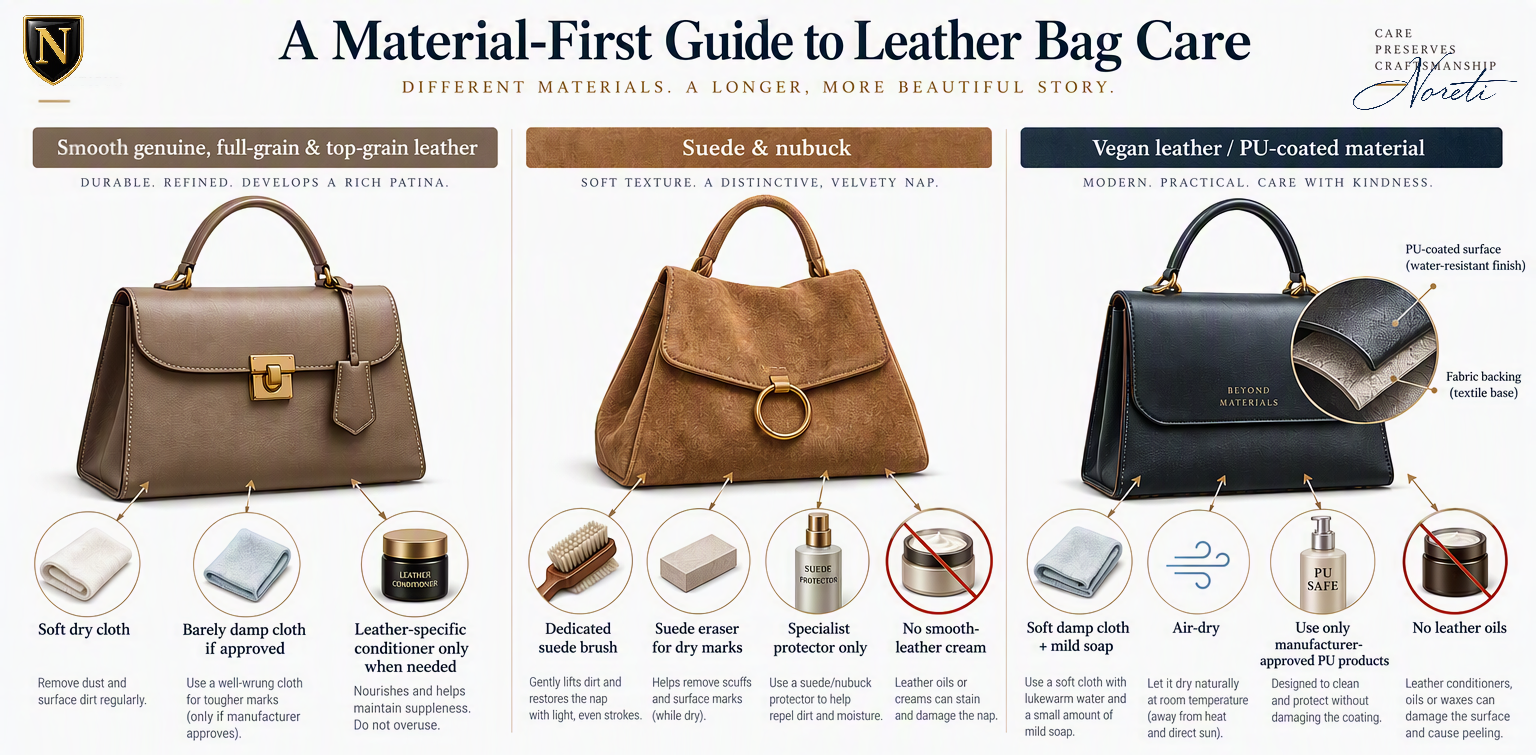
Figure 1: A material-first leather bag care guide: smooth leather, suede or nubuck, and vegan leather require different cleaning and protection methods.
A Simple Routine for Smooth Leather Bags
For most finished genuine, full-grain and top-grain leather bags, the best routine is deliberately understated.
1. Empty and inspect the bag
Remove everything from the main compartment and pockets. Gently shake out loose debris, then inspect the handles, corners, base and areas around the hardware. What appears to be dirt may sometimes be surface wear or a change in the finish, which should not be treated by vigorous rubbing.
2. Remove surface dust
Wipe the exterior with a clean, soft, lint-free cloth. Pay attention to seams, folds and handles, where dust and natural skin oils tend to collect. A dry cloth is often all that is required for routine leather bag care.
3. Spot-clean carefully
If the manufacturer permits damp cleaning, lightly moisten a soft cloth with clean, lukewarm water. The cloth should be barely damp—not wet. Blot or wipe gently without scrubbing, then remove residual moisture with a second dry cloth.
For more persistent surface dirt, use a cleaner specifically approved for the particular leather and finish. Apply it to the cloth rather than directly to the bag, and always test it first on an inconspicuous area. If the leather darkens, becomes tacky or changes texture, stop immediately.mimco+1
4. Allow the bag to air-dry
Let the bag dry naturally at room temperature, away from direct sunlight, heaters and hair dryers. Heat can accelerate moisture loss, while prolonged light exposure can fade color and weaken leather over time.coach+1
For structured designs—such as professional backpacks, briefcases and travel bags in the NORETI collection—lightly support the interior while drying so the bag retains its intended form.
How to Condition Full-Grain, Top-Grain and Genuine Leather
Conditioning can help smooth leather remain supple, but more is not better. Heavy or repeated applications may darken the surface, soften the structure, create a sticky finish or attract dust. Some coated leathers may need little conditioning, while an open, natural finish may respond differently.
Use only a conditioner approved for the bag’s leather type and finish:
Clean the leather first.
Allow it to dry completely.
Patch-test the conditioner in a concealed area.
Apply a very small amount with a soft cloth.
Allow it to absorb, then gently buff away any excess.
Rather than conditioning to a rigid calendar, assess the bag’s use, climate and appearance. Condition when the leather begins to feel dry or when the manufacturer recommends it. Specialist guidance varies because leather finishing methods vary; this is precisely why product-specific instructions should take precedence over universal home remedies.
Caring for Suede and Nubuck Bags
Suede and nubuck should not be treated like smooth leather. Their beauty comes from the raised fibers—the nap—which can be flattened, darkened or made greasy by ordinary leather creams, waxes and oils.
For routine suede or nubuck care:
Allow wet mud or marks to dry before attempting removal.
Use a dedicated suede or nubuck brush to lift dust and restore the nap.
Brush gently and consistently rather than scrubbing.
Use a suede eraser for small, dry marks where appropriate.
Choose only cleaners, conditioners or protectors specifically formulated for suede or nubuck.
Test any protector on a concealed area before treating the entire bag.
If suede becomes wet, blot excess moisture without rubbing, allow it to air-dry completely and then brush the nap gently. Deep oil marks, dye transfer and widespread staining are best handled by a specialist. Suede and nubuck are comparatively absorbent, and unsuitable waxes or oils can create shine, clog the surface or cause permanent darkening.charleskeith+1
How to Care for a Vegan Leather Bag
“Vegan leather” does not describe one universal material. Many vegan bags use a fabric substrate with a polyurethane coating, while others incorporate recycled or bio-based components. Different constructions may require different protectors and cleaning products.fashionjournal
For most smooth, coated vegan leather bags:
Remove dust with a soft, dry cloth.
Wipe light marks with a slightly damp microfiber cloth.
If permitted, use a very small amount of mild soap diluted in water.
Remove any residue with a clean damp cloth.
Dry the surface and allow the bag to air naturally.
Do not automatically apply oils or conditioners made for animal leather. A coated material cannot be assumed to absorb them in the same way, and unsuitable products may leave a greasy residue or affect the coating. If additional protection is needed, use only a product approved for the particular PU, plant-based or alternative material and patch-test it first.fashionjournal+1
Keep vegan leather away from prolonged sunlight and heat, avoid overfilling, and store it with sufficient air circulation. If it becomes wet, remove surface moisture promptly and let it dry naturally.colourlockaustralia
What to Do When Your Leather Bag Gets Wet
For smooth leather:
Blot—not rub—with a clean, absorbent cloth.
Empty the bag if necessary.
Support its shape loosely with plain, colorfast tissue or a soft cloth.
Leave zippers or compartments open for ventilation.
Allow it to dry slowly at room temperature.
Do not place the bag in direct Australian sun, inside a hot car, against a heater or beneath a hair dryer. Once completely dry, assess whether the leather feels unusually stiff before considering a manufacturer-approved conditioner.
Important: Leather finishes vary considerably between manufacturers. Before applying any cleaner, conditioner, waterproofing spray, or protector, always follow the care instructions provided for your specific product and test any treatment on a discreet area first.
Responding to Common Stains
Speed matters, but restraint matters more.
Water: Blot immediately and let the area dry naturally.
Oil or grease: Do not rub or introduce more water. Blot the surface and seek professional assistance if the mark remains.
Ink: Avoid improvised solvents. Ink can spread or remove the leather’s finish, so specialist cleaning is usually the safer choice.
Makeup and perfume: Blot promptly. Alcohol, fragrance oils and cosmetics can affect dyes and coatings.
Mould: Isolate the bag from other leather goods and consult a leather-care professional, particularly if the growth is extensive or returns after drying.
Household stain removers, alcohol, bleach, antibacterial wipes and abrasive cleaners may strip color or alter the finish. Advice involving vinegar, rubbing alcohol or other solvents varies significantly between manufacturers; without explicit approval for the exact material, these treatments are an unnecessary risk.
How to Store a Leather Bag Properly
Thoughtful storage protects both the leather and the construction.
Store the bag in a cool, dry and ventilated place.
Keep it away from prolonged direct sunlight.
Use a breathable dust bag rather than sealing it in plastic.
Lightly fill the interior to preserve its shape, but do not overstuff it.
Store structured bags upright where possible.
Do not place heavy objects on top.
Avoid hanging a heavily loaded bag by its handles for extended periods.
Make sure the bag is completely dry before storing it.
Supporting the interior helps prevent permanent creasing and compression, while avoiding excessive stuffing protects the leather, seams and stitching from tension.
The Essential Leather Bag Care Checklist
Do:
Identify the leather and finish before treatment.
Follow the bag maker’s care instructions.
Patch-test every new product.
Dust regularly with a soft cloth.
Blot spills promptly.
Air-dry away from heat and direct sunlight.
Store supported in a breathable dust bag.
Avoid:
Soaking or machine-washing the bag.
Aggressive scrubbing.
Baby wipes and antibacterial wipes unless explicitly approved by the manufacturer.
Bleach, alcohol, perfume and general household cleaners.
Smooth-leather creams on suede or nubuck.
Animal-leather oils on coated vegan materials.
Over-conditioning or heavy waterproofing treatments.
Storing the bag while damp.
Care as a Form of Appreciation
The finest leather care is quiet and consistent. It preserves the bag without disguising the natural evolution that makes a well-used piece distinctly personal.
By understanding the material, responding gently to spills and storing the bag with care, you allow craftsmanship to reveal itself over time. Explore the NORETI collection of leather goods and refined everyday accessories—pieces created to be carried with confidence, cared for with intention and enjoyed well beyond a single season.
Because exceptional craftsmanship deserves exceptional care.
NORETI™ | The Art of Distinction
*** Resources & Further Reading***
At NORETI, we believe informed ownership is part of true craftsmanship. The following resources provide additional guidance on leather care, preservation, and material-specific maintenance.
Leather Care & Preservation
Canadian Conservation Institute – Comprehensive guidance on the long-term care, storage, humidity control, and preservation of leather goods and leather products.
Coach Australia Product Care Guide – Practical recommendations for cleaning, conditioning, and caring for different leather finishes, including smooth leather, pebbled leather, and specialty leathers.
Suede & Nubuck Care
Leather Hero Australia – Specialist advice for cleaning, conditioning, protecting, and maintaining suede and nubuck leather. Particularly useful for understanding the differences between unfinished and finished leathers.
Vegan Leather Care
Louenhide Care Guide – Practical care recommendations for PU and vegan leather accessories, including cleaning, storage, and moisture management.
Fashion Journal: Vegan Leather Care – Expert insights from the Australian accessories industry on protecting and storing modern vegan leather materials.

How to Choose a Luxury Leather Bag: 7 Details That Define True Quality
Luxury is not defined by a logo or a price tag. It is revealed in the details. From the quality of the leather to the precision of the stitching, the strength of the hardware, and the craftsmanship behind every seam, a truly exceptional leather bag is designed to last for years while developing character over time. In this guide, discover the seven essential qualities that distinguish a genuine luxury leather bag and learn what to look for before investing in your next briefcase, backpack, handbag, or travel companion.
When shopping for a leather bag, it's easy to be distracted by branding, marketing, or price tags. Yet true luxury isn't defined by a logo. It's found in the quality of the materials, the precision of the craftsmanship, and the way a bag performs and ages over time.
A well-made leather bag should look as beautiful after years of use as it did on the day it was purchased. Understanding what separates exceptional craftsmanship from ordinary construction can help you invest with confidence and choose a piece that becomes a long-term companion rather than a short-lived accessory.
Whether you're considering a briefcase, backpack, handbag, or travel bag, here are seven details that define genuine quality.
1. Leather Quality: The Foundation of Every Luxury Bag
The quality of the leather is arguably the most important factor when evaluating a bag. Not all leather is created equal, and terms such as genuine leather can often be misleading.
Full-Grain Leather
Full-grain leather is widely regarded as the highest quality leather available. It retains the natural grain layer of the hide, preserving the strongest fibres and allowing the material to develop a rich patina over time. Because the surface is not sanded or corrected, natural markings remain visible, giving each piece its own character. Sources consistently identify full-grain leather as the most durable and longest-lasting leather grade.
Top-Grain Leather
Top-grain leather is also a premium material. It comes from the same upper section of the hide but is lightly sanded to create a more uniform appearance. It remains durable and refined while offering a smoother finish and increased stain resistance.
Genuine Leather
Despite its name, "genuine leather" is not necessarily a sign of high quality. In many cases, it refers to lower layers of the hide that have undergone more extensive processing. While still real leather, it typically offers less durability and character than full-grain or top-grain alternatives.
What to Look For
Before purchasing a leather bag, ask:
What type of leather is used?
Is it full-grain or top-grain?
Does the brand clearly explain its materials?
Will the leather develop a natural patina with use?
Luxury begins with transparency and quality materials.
2. Stitching: The Signature of Craftsmanship
One of the quickest ways to assess a luxury leather bag is to examine its stitching.
High-quality stitching should be:
Straight and evenly spaced
Consistent throughout the bag
Tight without loose threads
Reinforced at stress points
Uneven stitching often indicates rushed manufacturing and can lead to premature failure in areas that experience regular tension.
Look closely around:
Handles
Shoulder straps
Corners
Zipper attachments
Internal compartments
Luxury craftsmanship is often subtle. The finest bags do not draw attention to their construction, because every stitch is executed with precision.
Hand-finished details, reinforced seams, and carefully aligned stitching patterns are all signs that a manufacturer takes pride in its work.
3. Hardware: Why the Smallest Components Matter
Many luxury bags fail not because of the leather, but because of inferior hardware.
Zippers, buckles, clasps, rivets, and magnetic closures endure thousands of interactions during a bag's lifetime. They should feel substantial, operate smoothly, and show no signs of weakness.
Quality Hardware Characteristics
Look for:
Solid brass, stainless steel, or premium alloy hardware
Smooth-running zippers
Secure clasps and closures
Consistent metal finishes
Corrosion-resistant coatings
Premium zipper manufacturers such as YKK, Riri, and Lampo have earned reputations for reliability and precision across luxury goods industries. High-end hardware is often engineered for extensive use and contributes significantly to a product's durability and overall quality perception. [selvane.co], [selvane.co], [bespoke-bags.com]
Quick Hardware Test
Open and close the zipper several times.
A quality zipper should:
Glide effortlessly
Avoid catching on leather edges
Feel secure when closed
Operate consistently without excessive force
Luxury should feel effortless.
4. Construction: What's Beneath the Surface
Beautiful leather alone does not make a luxury bag. Construction determines whether the bag will maintain its shape and performance over time.
Premium bags typically include structural reinforcement in critical areas such as:
Base panels
Corners
Strap attachments
Carry handles
A well-constructed bag will feel solid without appearing bulky.
Shape Retention
Pay attention to how the bag stands when placed on a surface.
Quality bags tend to:
Hold their intended shape
Resist sagging
Maintain clean silhouettes
Distribute weight evenly
A collapsing or twisting shape can be a sign of weak internal structure.
Edge Finishing
The edges of luxury leather products receive significant attention during manufacturing.
Look for:
Smooth painted edges
Clean fold-over construction
Uniform finishing
No exposed fibres
Well-executed edge finishing improves both durability and visual refinement.
5. Functionality: Luxury Should Work for Your Lifestyle
A luxury leather bag can be beautifully made and still be the wrong choice if it doesn't suit your daily needs.
Before purchasing, consider how you'll actually use the bag.
For Professionals
A briefcase or business bag should accommodate:
A laptop
Documents
Daily essentials
Organised internal compartments
For Travel
A travel bag should offer:
Durable carry handles
Reinforced base construction
Secure closures
Efficient storage capacity
For Everyday Use
An everyday backpack or handbag should balance:
Comfort
Accessibility
Weight
Practical storage
True luxury is not only about appearance. It is about enhancing daily life through thoughtful design.
6. Timeless Design: Beyond Short-Term Trends
Fashion changes quickly. Exceptional design endures.
Many of the world's most admired leather goods maintain remarkably consistent silhouettes year after year because timeless design transcends trends.
Signs of Timeless Design
Look for:
Clean lines
Balanced proportions
Minimal unnecessary embellishments
Thoughtful colour choices
Functional elegance
Neutral shades such as black, navy, tan, cognac, and deep brown often provide greater versatility and longevity than trend-driven colours.
Rather than asking whether a bag is fashionable today, ask:
Will I still enjoy carrying this five years from now?
Luxury is often characterised by restraint rather than excess.
7. Reputation, Transparency and Craftsmanship Story
The finest leather brands are usually willing to explain how their products are made.
Look for brands that openly discuss:
Material sourcing
Leather grades
Construction methods
Hardware specifications
Craftsmanship processes
When a brand educates customers about quality rather than relying solely on marketing language, it often demonstrates confidence in its product.
Transparency builds trust and helps buyers make informed decisions.
Final Checklist: 7 Things to Examine Before Purchasing
Before investing in a leather bag, take a few moments to inspect the following:
✅ Is the bag made from full-grain or premium top-grain leather?
✅ Are the stitches straight, consistent, and reinforced?
✅ Do the zippers, buckles, and fittings feel solid and operate smoothly?
✅ Does the structure hold its shape well?
✅ Are the edges neatly finished and protected?
✅ Does the design suit your lifestyle and everyday needs?
✅ Will the design remain relevant and elegant for years to come?
If a bag performs well across all seven areas, there's a strong chance you're looking at a piece built to deliver genuine long-term value.
The NORETI Philosophy
At NORETI, we believe luxury is created through craftsmanship, thoughtful design, and a commitment to quality materials. Every leather bag should be more than an accessory. It should become part of your journey, gaining character and distinction with every year of use.
Explore our collection of premium briefcases, backpacks, handbags, and travel accessories, and discover the details that define true craftsmanship.